uae golden visa for teachers cost
UAE Golden Visa for Teachers Cost 2026: Who Pays
Every write-up of the teachers' Golden Visa tells you the nomination is free and then points you at the GDRFA website for the price. That is the whole problem: the UAE Golden Visa for teachers cost is split across three authorities, and the only one anybody writes about is the one that charges you nothing. We read Ras Al Khaimah's own eligibility policy, GDRFA Dubai's fee table for the education route and the ICP's specialised-talents service sheet, and priced what a nominated teacher actually pays.
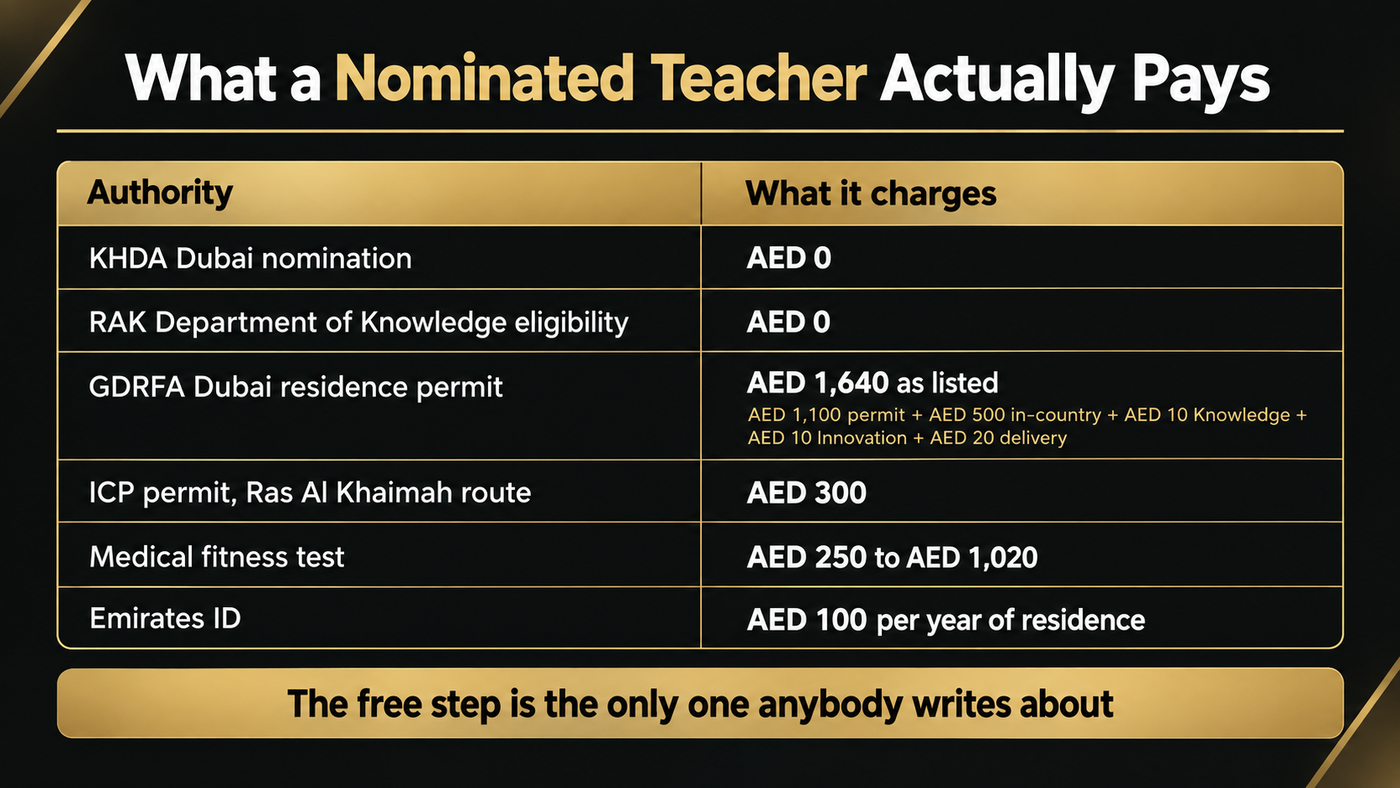
Three authorities, and only one of them sends you a bill
A teachers' Golden Visa is not one transaction. It is a nomination or eligibility letter from an education authority, an approval from the federal identity authority, and a residence permit issued by whichever immigration authority covers your emirate. Each has its own paperwork, its own clock and its own price list, and the reason the cost is so hard to find written down is that the step every headline is about happens to be the free one.
Ras Al Khaimah's Department of Knowledge says so in its own policy document: it does not charge an application fee for the eligibility review, and notes that Golden Visa processing fees may apply when the file reaches the ICP. Dubai's route runs through your school rather than through you, so there is no invoice at that stage either. What KHDA did publish when the scheme opened is blunter about the rest: you cover the visa costs unless your institution agrees to pay them on your behalf.
So the honest answer is nothing to be found eligible, then the ordinary price of a ten-year golden residence — for which two different authorities publish two different numbers. On this page we work through them in order: what the Dubai route asks of you and who can be nominated, what Ras Al Khaimah's policy asks in far more specific terms, the second door that wants an AED 30,000 salary instead of a nomination, GDRFA Dubai's published permit fees, the ICP's published fees and why they are lower, the costs that appear in neither table, and the timing that decides which academic year you do this in.
- Nomination or eligibility review — no fee published by either education authority.
- Dubai-issued permit, GDRFA fee table — AED 1,640 as listed.
- Ras Al Khaimah route, ICP service sheet — AED 300 across three lines.
- Outside both tables — medical fitness test, Emirates ID, health insurance, degree recognition.
- Who pays — the applicant, unless the school agrees otherwise.
Fees are set by the authorities and change without notice. Every figure below comes from an authority's own service page or policy document, and should be confirmed against that page before you budget against it.
What the Dubai route asks for, and who can be nominated
KHDA opened the Golden Visa to Dubai's private education sector in October 2024, and the list of roles it set out then reaches well beyond classroom teaching. Principals and leaders of private schools, managers of private early childhood centres, academic heads of KHDA-licensed higher education institutions, teachers in private schools and early childhood centres, and full-time faculty and senior administrative leaders at those higher education institutions were all named as eligible.
The criteria are qualitative rather than numeric, which is the first thing to understand about budgeting for this route: there is no threshold you can check yourself. KHDA framed them as exceptional academic achievements and innovative contributions to education, proven success in raising the quality of education at the institution, a positive impact and recognition from the wider educational community, and proven contributions to improving student outcomes, including academic progress and the attainment of recognised qualifications.
The second thing is that you cannot file it. The nomination belongs to your institution. You raise it with the head of your school, centre or faculty; if they support it, they open the nomination in KHDA's system; each institution forms an internal committee that reviews its own candidates before anything reaches KHDA. Approved educators then apply for the residence permit through GDRFA, and the whole sequence was put at roughly 45 working days from the point where the documentation is complete and approved.
- Who nominates — your school, early childhood centre or higher education institution, not you.
- Internal step — each institution forms a committee to review candidates before submission to KHDA.
- Nomination window — mid-October to mid-December, run annually since the scheme opened.
- After approval — the residence permit application goes to GDRFA Dubai.
- Stated end-to-end time — about 45 working days once documentation is complete.
The window and the role list are as published when the scheme launched. Confirm the current cycle's dates and criteria with KHDA directly before you plan an application around them, because the nomination is annual and the detail can move between cycles.
What Ras Al Khaimah asks for, in writing
Ras Al Khaimah publishes the thing Dubai's route leaves to a committee: a policy document, issued 17 October 2024, that sets out the criteria for each category line by line. If you want to know whether you qualify before spending anything, this is the more useful document of the two, and it applies to teachers, principals and leaders in RAK private schools.
For a teacher, the policy asks for an appointment letter from the Ministry of Education or the Department of Knowledge, an advanced degree — a master's or a PhD — obtained outside the UAE, and at least three years of both residing and working in Ras Al Khaimah, evidenced by an employment letter showing hiring dates plus an attested lease or a property ownership contract in the emirate. On top of that you supply evidence of meeting at least three of six contribution criteria, and confirmation that your contract has been renewed with the same school for the coming academic year.
For principals and school leaders the shape changes. The appointment letter and the three-year residence and employment rule stay, and so does the advanced degree, recognised by the Ministry of Education where it was earned abroad. What replaces the three-of-six test is harder: the leader must have improved the school's overall performance rating — the policy gives acceptable to good, or good to very good, as the examples — evidenced by the Ministry of Education inspection or quality evaluation report, plus an endorsement letter on school letterhead signed by the chairperson of the board of governors.
- Demonstrated positive contributions to student learning outcomes.
- Positive feedback from students, parents and school leadership.
- Awards, honours or formal recognition for educational contributions at regional or national level.
- Positive impact on students of determination.
- Introduction of innovative teaching methods and effective integration of technology.
- Active participation in professional development.
The policy's own FAQ closes several doors explicitly: you must be employed at a private school inside Ras Al Khaimah, residing there is not enough on its own; school administrators and board members are not eligible; and a principal who improved compliance without raising the Ministry of Education quality rating cannot use that as evidence of school improvement.
The other door, and why most teachers cannot use it
There is a second way into a golden residence that has nothing to do with being nominated, and understanding it is what makes the nomination routes worth the paperwork. GDRFA Dubai's service page for specialised scientists and professionals lists its requirements by field, and the entry for elite education fields is three items long: a copy of the applicant's passport, a nomination letter from the Ministry of Education or the relevant local authorities, and approval issued by the federal identity authority. That is the whole document list. No salary figure appears in it.
Directly below it sits the specialists route, and that one is numeric. It asks for a work permit against a valid employment contract, classification as a skilled worker at the first or second professional level under the Ministry of Human Resources and Emiratisation scheme, a bachelor's degree or better with a recognition certificate from the Ministry of Education, a valid licence to practise where the profession requires one — GDRFA names teacher in that list alongside physician and pharmacist — and a monthly salary of not less than approximately AED 30,000.
AED 30,000 a month is AED 360,000 a year. Commercial salary surveys for UAE private-school teaching commonly quote ranges running from roughly AED 8,000 to AED 25,000 a month, and while those are recruitment-industry estimates rather than official statistics, the gap they describe is the point. For most classroom teachers the salary door is closed, and the nomination door is the one that opens. There is a second reason to prefer it: GDRFA states that where the salary falls below AED 30,000 or the contract is cancelled, the golden residence permit will be cancelled. A permit granted against a nomination is not pinned to a payslip in the same way.
- Elite education fields — passport, nomination letter, federal identity authority approval. No published salary floor.
- Specialists — MoHRE professional level 1 or 2, bachelor's minimum with Ministry of Education recognition, professional licence where required.
- Specialists salary condition — not less than approximately AED 30,000 a month.
- Continuing condition on the salary route — GDRFA states the permit is cancelled if the salary drops below AED 30,000 or the contract ends.
- Both routes — valid comprehensive health insurance for the applicant and family at the point of application.
Salary ranges quoted for teaching roles are commercial survey estimates, not government figures. The AED 30,000 threshold, by contrast, is published by GDRFA on its own service page, and it is the number that decides which door you are using.
What GDRFA Dubai charges for the permit itself
For a permit issued in Dubai, GDRFA publishes an itemised schedule on the golden residence service page rather than a single headline price. The residence permit fee is AED 1,100. A Knowledge Dirham of AED 10 and an Innovation Dirham of AED 10 are added, along with a fee inside the country of AED 500 and delivery of AED 20. Those lines come to AED 1,640 as listed.
One footnote moves the total, and it matters more on this route than on most: GDRFA notes that the issuance fee increases by AED 100 for each year where the residency period runs beyond two years. A teachers' golden residence is a ten-year permit, so it is charged above the base table, and any quote that prints AED 1,640 as a final figure has skipped the note under it.
The service itself is quick once the nomination has done its work. GDRFA puts expected completion at 48 hours and offers two channels: the smart services system, logging in through UAE Pass, or an Amer service centre in person. The centre route adds a typing or handling fee that GDRFA does not publish, because it is charged by the centre rather than by the authority. That is the first of several costs on this page that exist without appearing on anybody's official list.
- Residence permit fee — AED 1,100.
- Knowledge Dirham — AED 10. Innovation Dirham — AED 10.
- Fee inside the country — AED 500. Delivery — AED 20.
- Listed total — AED 1,640, before the annual increase.
- Published increase where the residency runs over two years — AED 100 per year.
- Expected completion — 48 hours, via UAE Pass or an Amer service centre.
GDRFA also attaches continuing conditions to the permit: holders must be able to support themselves and their family without government support, and final approval rests with GDRFA Dubai after it reviews the file. Golden residence holders are exempt from the 180-day stay-abroad rule, with the permit void only if it expires while the holder is outside the country.
What the ICP charges, and why the Ras Al Khaimah number is lower
Outside Dubai the permit is issued by the ICP, and its service for individuals with specialised talents is where a Ras Al Khaimah eligibility letter lands. The service is described as issuing a visa for exceptional talents to complete the procedures for obtaining the golden residence for a period of ten years, and it publishes three fee lines: an application fee of AED 100, an issuance fee of AED 100 and a smart services fee of AED 100. That is AED 300.
The document list confirms that the nomination is the qualification. Alongside the passport and photograph, the ICP requires, for exceptional talents, a recommendation or approval from the competent federal or local government authorities — which is precisely what a Department of Knowledge eligibility letter is. Two conditions sit above the fees: valid health insurance within the UAE, and a passport valid for no less than six months. The service is completed in two days, through the ICP smart app or smart services website, and requires a UAE Pass login.
The gap between AED 300 and AED 1,640 is not a discount anybody is offering you. They are two authorities publishing two schedules built differently, and neither reconciles itself against the other. What it does mean in practice is that the emirate your school sits in changes the permit line on your budget by more than a thousand dirhams, before a single one of the costs in the next section is counted.
- Application fee — AED 100.
- Issuance fee — AED 100.
- Smart services fee — AED 100.
- Published total — AED 300, with a stated completion time of two days.
- Conditions — valid UAE health insurance and a passport valid for at least six months.
- Required from a nominated educator — a recommendation or approval from the competent federal or local government authority.
The ICP also lists a fine of AED 50 per day where the permitted stay expires, which is worth knowing if you are switching from an employer-sponsored visa and the timing slips between the two.
The costs that appear in neither fee table
Neither the GDRFA schedule nor the ICP's three lines is an all-in price, and the items they leave out are not small. The medical fitness test is the clearest example: it is a residence permit requirement rather than a golden visa line item, so it is priced by the health authority instead. Dubai Health Authority publishes AED 250 for the regular service at 24 working hours, AED 700 for express at six working hours, AED 700 at the Smart Salem centre for a result in about 30 minutes, and AED 1,020 for the VIP service at two working hours. The certificate is identical in every tier; what you are buying is turnaround.
The Emirates ID is the other one, and it is the cost that scales. The ICP prices the card at AED 100 for each year of residence, plus AED 100 in smart service fees, with urgent handling at AED 150. On a ten-year permit that is AED 1,100 per person — more than three times the ICP's entire permit fee, and within touching distance of GDRFA's whole Dubai schedule. Everyone on the file gets their own card and pays their own line.
Two more sit quietly behind the criteria. Health insurance valid in the UAE is a stated condition on both routes, for the applicant and for family members, and it is charged on the insurer's cycle rather than the permit's. Degree recognition is the one most likely to surprise a teacher: both Ras Al Khaimah's leader criteria and GDRFA's specialists route call for a Ministry of Education recognition report where the qualification was issued outside the UAE, and the ministry's own service runs to 18 working days on top of whatever the verification and attestation cost. Add the typing or handling fee at an Amer or service centre, which no authority publishes, and the gap between the fee table and the bank statement is complete.
- Medical fitness test, DHA published tiers — AED 250 regular, AED 700 express, AED 700 Smart Salem, AED 1,020 VIP.
- Emirates ID — AED 100 per year of residence plus AED 100 smart services; AED 1,100 for a ten-year card.
- Emirates ID urgent handling — AED 150.
- UAE-valid health insurance — a stated condition on both routes, for the applicant and family.
- Ministry of Education recognition report where the degree was issued abroad — 18 working days, fees on the service page.
- Typing or service-centre handling — charged by the centre, published by nobody.
These are the published figures for Dubai. Medical fitness fees are set by each emirate's health authority and the centre performing the test, so confirm the schedule that applies where you will sit the test rather than carrying the DHA tiers across.
SafetyWing sells travel medical cover for periods between UAE-licensed policies — a summer outside the country between contracts, for instance. It is not a UAE-licensed health policy, it does not satisfy the health insurance condition on either Golden Visa route, and it has no bearing on a nomination or an application. The cover your file needs has to be UAE-valid.
Sponsored link. We may earn a commission at no cost to you.Timing decides which academic year you do this in
The expensive part of this process is not money, it is the calendar. Dubai's nominations run in an annual window from mid-October to mid-December, and if your institution's internal committee does not put your name forward inside it, the next opportunity is a year away. Ras Al Khaimah has not fixed a window: its policy says submission windows or deadlines, if any, will be announced by the Department of Knowledge, and invites applicants to check for updates rather than wait for a date.
Once a file moves, it moves quickly. The Department of Knowledge puts its typical review at two weeks. The GDRFA permit step is 48 hours and the ICP's is two days. Set against KHDA's roughly 45 working days end to end, that arithmetic tells you where the time actually goes: into the education authority's assessment and into assembling your own evidence, not into the immigration counter at the end.
Two eligibility conditions are tied to the same calendar and are worth checking before you start. Ras Al Khaimah requires the three years of residence and employment to be complete at the time of application — its FAQ refuses applicants who will reach three years shortly — and the teacher criteria ask for a contract renewed with the same school for the upcoming academic year, which pins the application to your school's renewal cycle rather than to the visa cycle. Afterwards the admin is light: no annual renewal with the Department of Knowledge, though a change of employment or school has to be reported, and a change of school ownership or management does not affect eligibility on its own. Family members may then qualify under your sponsorship, and if you are already on an investor or spouse visa you can transfer once the educator visa is granted.
- Dubai nominations — annual window, mid-October to mid-December.
- Ras Al Khaimah — no fixed window; the Department of Knowledge announces any deadlines.
- Department of Knowledge review — about two weeks.
- Permit issuance — 48 hours at GDRFA, two days at the ICP.
- Dubai end to end — roughly 45 working days once documentation is complete.
- Three-year rule — must be complete at the time of application, not shortly after it.
None of these timings is a guarantee, and a nomination is not an approval. Both education authorities assess evidence, and the immigration authority evaluates the file again afterwards. Budget for the possibility that a cycle ends without a permit and the evidence has to be rebuilt for the next one.
Common questions
How much does the UAE Golden Visa cost for teachers?
The eligibility step is free at both education authorities, and the permit is then charged by whichever immigration authority covers your emirate. GDRFA Dubai publishes AED 1,100 for the residence permit, AED 500 inside the country, AED 10 each for the Knowledge and Innovation Dirhams and AED 20 delivery, which is AED 1,640 as listed, plus a stated AED 100 increase for each year beyond two. The ICP, which issues on the Ras Al Khaimah route, publishes AED 100 application, AED 100 issuance and AED 100 smart services, which is AED 300. The medical fitness test, Emirates ID, health insurance and any degree recognition are on top of both.
Does KHDA or RAK DOK charge a fee to apply?
Ras Al Khaimah's Department of Knowledge states in its policy that it does not charge an application fee for the eligibility review, and adds that Golden Visa processing fees may apply when the documents go to the ICP. Dubai's nomination is submitted by your institution through KHDA's system rather than bought by you. KHDA's guidance when the scheme opened put the visa cost itself on the applicant unless the institution agrees to cover it.
Do teachers need to earn AED 30,000 a month to get a Golden Visa?
Not on the nomination route. GDRFA's requirement list for elite education fields is a passport, a nomination letter from the Ministry of Education or the relevant local authorities, and approval from the federal identity authority, with no salary figure attached. The AED 30,000 monthly salary belongs to the separate specialists route, which also requires MoHRE professional level 1 or 2, a recognised bachelor's degree and a professional licence, and which GDRFA says is cancelled if the salary later falls below that level or the contract ends.
Can a teacher apply for the Dubai Golden Visa without their school?
No. The Dubai route is an institutional nomination: you raise it with the head of your school, centre or faculty, they open it in KHDA's system if they support it, and an internal committee reviews candidates before anything is submitted. Ras Al Khaimah's route begins with the educator submitting to the Department of Knowledge, but it still requires an appointment letter and, for teachers, evidence that the school has renewed the contract for the coming academic year, and the Department contacts the principal to verify.
What qualifications does a teacher need for the Ras Al Khaimah Educator Golden Visa?
The policy asks for an appointment letter from the Ministry of Education or the Department of Knowledge, an advanced degree at master's or PhD level obtained outside the UAE, and at least three years of residing and working in Ras Al Khaimah, evidenced by an employment letter and an attested lease or property ownership contract. You also supply evidence of meeting at least three of six contribution criteria and confirmation that your contract has been renewed with the same school for the upcoming academic year.
When can teachers apply for the Dubai Golden Visa?
KHDA has run the nomination as an annual window from mid-October to mid-December since the scheme opened in October 2024. Because the cycle repeats and the detail can change between cycles, confirm the current dates with KHDA before planning around them. Ras Al Khaimah has not published a fixed window; its policy says submission windows or deadlines, if any, will be announced by the Department of Knowledge.
Can a teacher on a Golden Visa sponsor their family?
Yes. Ras Al Khaimah's policy states that once the educator Golden Visa is approved, family members including a spouse, parents and children may qualify for Golden Visas under the holder's sponsorship. Budget for it separately, because each person carries their own Emirates ID at AED 100 per year of residence, their own medical fitness test and their own health insurance, none of which is inside the permit fee.
What happens if I change schools after getting the visa?
Ras Al Khaimah's policy does not require an annual renewal with the Department of Knowledge, but it does require any change in your employment status or school to be reported, and a change in the school's ownership or management does not by itself affect eligibility provided you remain employed and continue to meet the criteria. The rules differ by authority and by route, so confirm with the authority that issued your eligibility letter rather than assuming this carries across emirates.
Sources to verify before applying
- Ras Al Khaimah Golden Visa Policy for Private School Educators — eligibility criteria and FAQsRas Al Khaimah Department of Knowledge
- Ras Al Khaimah Educators Golden Visa — scope, eligible roles and application processRas Al Khaimah Department of Knowledge
- Issuing Golden Residence Permit (Specialized Scientists) — elite education fields, specialists and published feesGDRFA Dubai
- Issuance of a Residence Visa for Individuals with Specialized Talents — fee lines and required approvalsFederal Authority for Identity, Citizenship, Customs and Port Security
- Golden visaThe Official Portal of the UAE Government
- Medical Fitness Centres Service Catalogue — published screening fee scheduleDubai Health Authority
- New Identity Card Issuance — published fee scheduleFederal Authority for Identity, Citizenship, Customs and Port Security
- Recognition of higher education qualifications issued outside the UAEMinistry of Higher Education and Scientific Research
Compare UAE Golden Visa providers.
Get a line-item quote before you pay. Ask providers to separate government charges, document costs, and service fees.
We may earn a referral fee if you choose an advisor or provider through this site. That does not change our requirement to describe fees and eligibility conservatively.