uae golden visa for scientists cost
UAE Golden Visa for Scientists Cost 2026
Search the UAE Golden Visa for scientists cost and the two pages that rank hardest publish no AED figure at all, while the one that does quotes a ten-year total near AED 2,790 that will not reconcile with the schedule it cites. The published lines are smaller, and they come from two authorities: GDRFA Dubai lists AED 1,640 at a stated 48 hours, the federal ICP lists AED 300 at a stated two days, and the nomination letter gating both appears on no fee schedule anywhere. We read GDRFA's Specialized Scientists service, the ICP's specialised-talents service and golden residency guide, the Abu Dhabi Residents Office criteria and the ICP's identity card schedule, then rebuilt the ten-year number from published lines only. On this page, in order: what each authority charges, why one permit has two prices, the AED 100-a-year line that moves the total, the nomination nobody prices, the citation metrics that decide whether you have a file, why the AED 30,000 salary bar is not yours, the costs that appear on no golden-visa page, what a family multiplies, and what a ten-year file adds up to.

What the two authorities actually publish
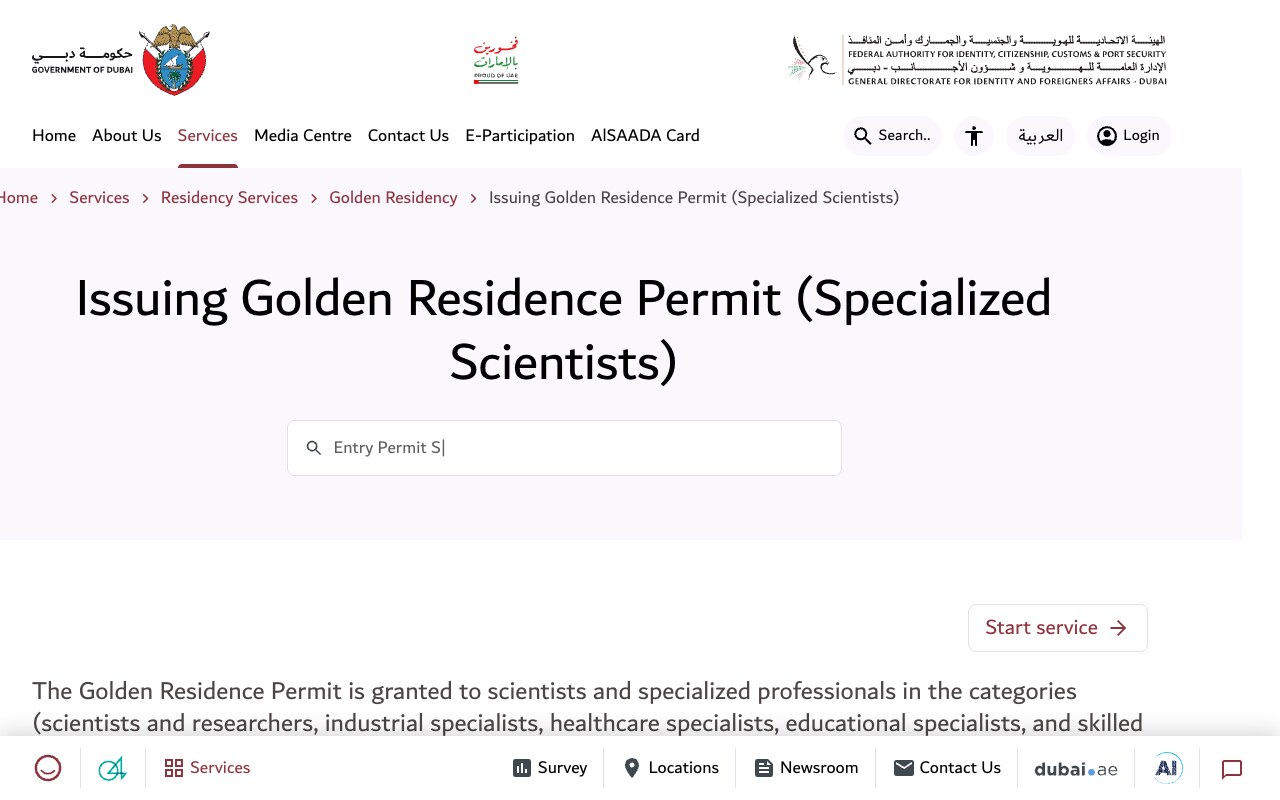
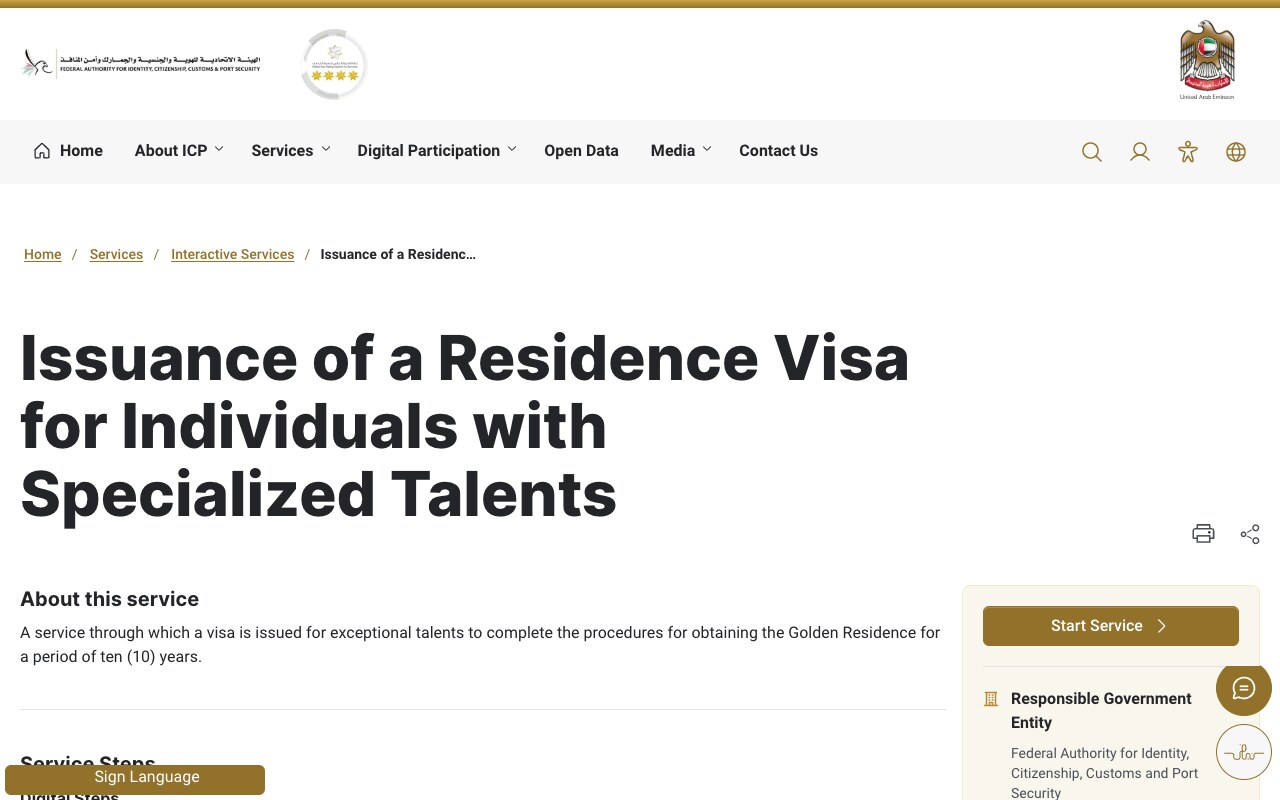
There is no single price for this permit, because two authorities issue it and each publishes its own schedule. GDRFA Dubai runs the service as Issuing Golden Residence Permit (Specialized Scientists). The federal Authority for Identity, Citizenship, Customs and Port Security runs it as Issuance of a Residence Visa for Individuals with Specialized Talents. You file through one of them, not both, and the number on your quote should tell you which.
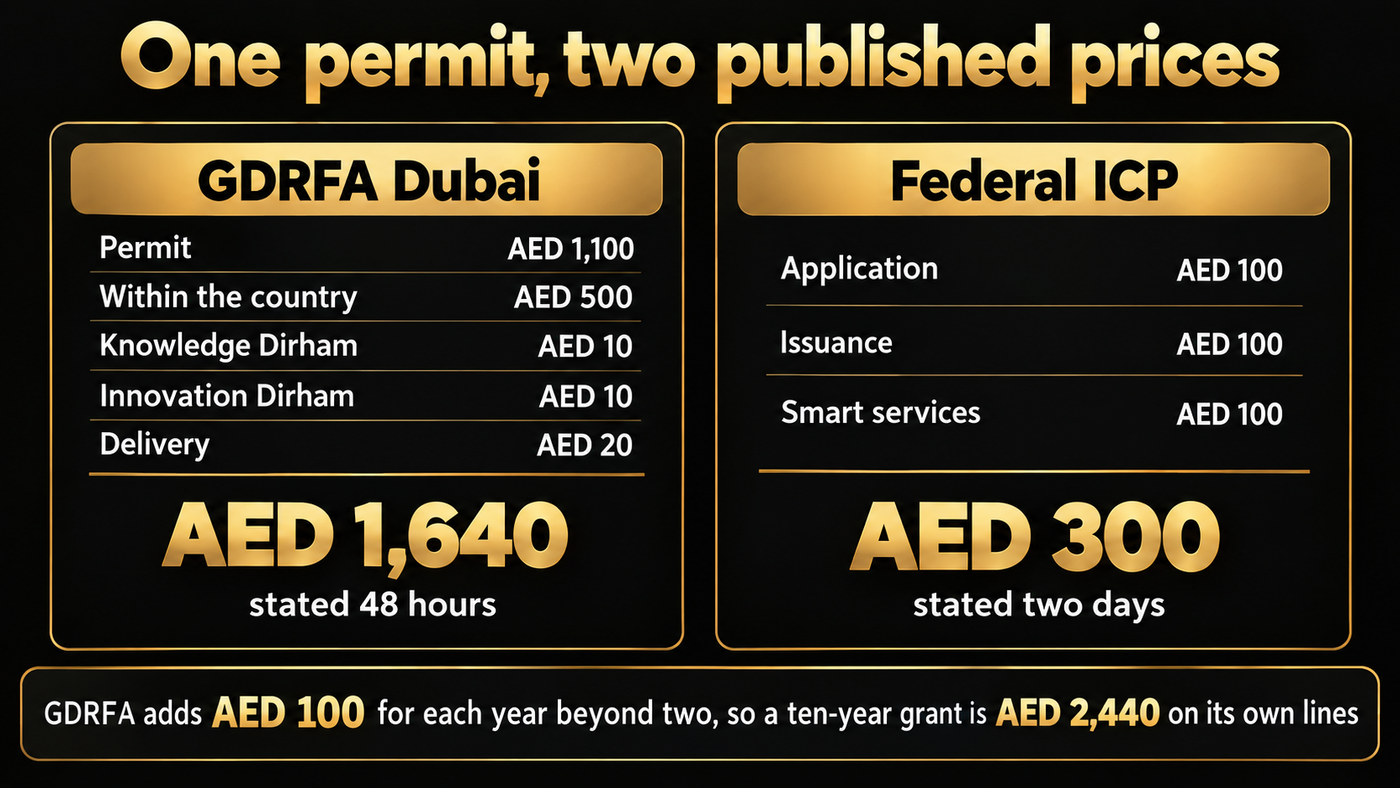
GDRFA's schedule is five lines: a residence permit fee of AED 1,100, a fee within the country of AED 500, a Knowledge Dirham of AED 10, an Innovation Dirham of AED 10, and delivery of AED 20. That is AED 1,640, at a stated 48 hours, through the digital channels or an AMER service centre.
The ICP's schedule is three lines of AED 100 each: application, issuance, and smart services. AED 300, at a stated two days, for the same ten-year golden residence, with valid UAE health insurance and a passport valid for no less than six months as stated conditions. The distance between AED 1,640 and AED 300 is not a discount and not an error on either page.
- GDRFA Dubai, Specialized Scientists: AED 1,100 permit, AED 500 within the country, AED 10 Knowledge Dirham, AED 10 Innovation Dirham, AED 20 delivery. AED 1,640 at a stated 48 hours.
- Federal ICP, specialised talents: AED 100 application, AED 100 issuance, AED 100 smart services. AED 300 at a stated two days.
- Both routes issue a ten-year renewable golden residence.
- Neither figure includes the Emirates ID, the medical fitness test, or health insurance.
Why one permit carries two prices
GDRFA is Dubai's own residency authority, so its fee page is a Dubai fee page. The ICP is the federal authority, and it is also the channel an Abu Dhabi applicant is pointed at: the Abu Dhabi Residents Office tells specialists to apply through the TAMM platform or through icp.gov.ae. The emirate that will host your residence largely decides which counter you stand at, and so which schedule prices your file.
The labels matter when you read a quote. GDRFA's AED 500 line is described as a fee within the country, which makes AED 1,640 an in-country figure rather than a universal one. If you would be applying from outside the UAE, confirm on the service page which lines apply before you accept a total built from them.
So a quote citing AED 1,640 and a quote citing AED 300 can both be honest, because each names an authority and reproduces its lines. A quote that names neither is not quoting a schedule at all. It is quoting itself.
The stated times are worth reading as narrowly as the fees. GDRFA puts expected completion at 48 hours and the ICP at two days, and both of those clocks start on a file the authority has already accepted. Neither figure covers the nomination that must come first, and neither is a promise: a request that goes back for a document restarts the wait. Treat 48 hours as the best case for the counter step rather than a timeline for the visa, and note that the GDRFA figure also has a moving part the ICP figure does not.
Fees are set by the issuing authorities and change without notice. Confirm every line here against the authority's own service page before you budget against it, and treat nothing on this page as a quotation or as advice about your eligibility.
The AED 100-a-year line that moves the total
GDRFA's schedule carries an additional charge of AED 100 per year for residency periods exceeding two years. A golden residence for a scientist runs ten years, so that line is not a footnote: read as the years beyond the first two, it is eight increments of AED 100, which is AED 800 on top of AED 1,640, for AED 2,440.
This is where circulating totals diverge, and it is worth being precise about why. One of the better-ranked commercial guides gives roughly AED 2,790 as the ten-year figure while citing the same GDRFA schedule, and the published lines we read do not reach it. The wording is not unambiguous, either: exceeding two years could also be read as charging for every year of a grant longer than two. What a reader can hold us to is that we named the reading we used and showed the arithmetic. A single rounded number cannot be checked at all.
The ICP page carries no equivalent escalator, which is part of why AED 300 stays AED 300 across a ten-year grant on that route. Either way the permit is the cheap part of this file, and the part that decides it has no price at all.
- AED 1,640, the published GDRFA lines.
- Plus AED 100 for each year beyond the first two, so AED 800 across a ten-year grant.
- AED 2,440 for a ten-year permit on the GDRFA route, on our reading of the wording.
- AED 300 on the federal ICP route, which publishes no per-year increase.
The nomination is the gate, and nothing prices it
GDRFA lists three documents for scientists and researchers: a copy of the passport, a nomination letter from the UAE Scientists Council, and approval from the Federal Identity Authority. The ICP's golden residency guide describes the category as scientists and researchers with significant achievements and high impact, on a recommendation from the Emirates Scientists Council, for ten years.
Other routes have other nominators. The Abu Dhabi Residents Office sets out a path for applicants with achievements in establishing research and development sectors, on a recommendation from the Ministry of Industry and Advanced Technology, and a separate ICP category covers leading scientists and religious scholars on a recommendation from the Ministry of Culture and Youth or the relevant local authority.
No authority we read publishes a fee for the nomination itself, and that absence cuts two ways. The step that decides whether your file exists is not a priced service, so it cannot be bought, and a provider charging a premium to secure it is charging for an outcome it does not control. A nomination is also not an approval: issuance stays the immigration authority's decision after its own verification. What the nominating bodies measure, though, is published, and unusually specific.
- Emirates Scientists Council: the recommendation named by both the ICP guide and GDRFA's document list.
- Ministry of Industry and Advanced Technology: the recommendation for the research-and-development achievements route.
- Ministry of Culture and Youth or the relevant local authority: the ICP's route for leading scientists and religious scholars.
- A fee for the nomination appears on none of these pages.
The citation metrics that decide whether you have a file
The Abu Dhabi Residents Office publishes the measurable criteria, and they are the clearest statement of the bar in any official source we found. The first route asks for a Master's or PhD in engineering, technology, life sciences or natural sciences, from a university in the global top 500 for a doctorate or the top 250 for a Master's, or either degree from an institution in the top 100 for that specialisation, combined with a Field Weighted Citation Index grade of 1.0 and an h-index grade of 10 or higher.
The second route drops the ranking and the FWCI entirely and asks for a Scopus h-index above 20. The third is the research-and-development achievements route, evidenced rather than scored, with the ministry recommendation behind it. One route, not all three, is what you need.
The evidence ADRO asks for is modest and specific: a link or screenshot showing an FWCI grade of 1.0 or higher, one showing an h-index of 10 or higher, the degree itself, an equivalency certificate from the Ministry of Education, and a CV. Before you pay anyone to assess your chances, spend twenty minutes in your own Scopus profile, because the two numbers gating the first route are ones you can read off it yourself.
That is also the cheapest due diligence available on this route, and it is worth doing before money moves. The metrics are assessed by the nominating body, not by the counter that issues the permit, so a file can be perfectly assembled and still never reach a fee schedule. GDRFA and the ICP each list approval from the Federal Identity Authority as a required document rather than an outcome they decide alone, which is another way of saying that the paid steps sit at the end of the process rather than the start. And one number that dominates every commercial page on this query turns out not to apply to you at all.
- Route one: top-500 PhD or top-250 Master's, or top-100 by specialisation, plus FWCI 1.0 and h-index 10 or higher.
- Route two: a Scopus h-index above 20, with no university ranking condition.
- Route three: achievements in establishing research and development sectors, on a Ministry of Industry and Advanced Technology recommendation.
- Evidence: FWCI and h-index links or screenshots, the degree, a Ministry of Education equivalency certificate, and a CV.
Why the AED 30,000 salary bar is not yours
The same GDRFA service page carries a second category alongside the scientists. Skilled workers there need a minimum monthly salary of AED 30,000, a valid employment contract or salary certificate, six months of bank statements showing the salary transfers, a bachelor's degree as a minimum with attestation, and a professional licence where one applies. The ICP's guide repeats the AED 30,000 condition for skilled professionals in senior occupational levels, alongside a valid UAE work permit and comprehensive health insurance.
Those conditions belong to that category. They are not on the scientists document list, which has no salary line, no contract and no bank statements, because this route is assessed on research impact rather than on pay. Most commercial pages ranking for the cost of this visa apply the salary bar to scientists anyway, often in the same breath as the nomination requirement that contradicts it.
The distinction is not pedantic, it is a cost. Evidence you do not need is still evidence a provider can bill you for assembling, and a salary threshold wrongly attached to your file can talk you out of applying when nothing published stops you. What does cost money sits outside every page advertising the permit fee.
The Emirates ID and the medical test are separate bills
The Emirates ID is a separate ICP service, priced by the length of the permit rather than as a flat fee. The identity card issuance schedule lists AED 100 for each year of residence plus AED 100 in smart service fees, with an optional AED 150 for urgent service, at a stated five days. On a ten-year golden residence that is AED 1,100, more than three times the entire permit fee on the ICP route.
The medical fitness test is priced by how fast you want it. The Dubai Health Authority's Medical Fitness Centres Service Catalogue lists AED 250 for the regular service at 24 working hours, AED 700 for the express service at six working hours, AED 700 at the Smart Salem centre for a result in about 30 minutes, and AED 1,020 for the VIP service at two working hours. It is the same certificate in each case; the money buys the queue position.
Neither line is optional and neither appears on the pages that advertise the permit fee, which is how a file priced at AED 300 becomes a file priced at AED 1,650 before anyone has been paid for their time.
- Emirates ID: AED 100 per year of residence plus AED 100 smart services, so AED 1,100 on a ten-year card, and AED 150 more for urgent service.
- Medical fitness in Dubai: AED 250 at 24 working hours, AED 700 at six hours, AED 700 at Smart Salem, AED 1,020 for VIP at two hours.
- Both are billed per person rather than per file, and both sit outside the permit schedules.
Degree recognition, insurance, and the fee nobody publishes
The degree equivalency is its own ministry fee. The Ministry of Higher Education and Scientific Research's recognition service lists report fees starting at AED 100 for the diploma and bachelor's categories, with a qualification verification fee of AED 350 through one of its approved partners. Confirm the band for a Master's or a doctorate on the service card, because the level you hold sets the price and a scientists file cannot skip this step.
Health insurance is a stated condition on both ICP pages, comprehensive and valid throughout the permit's validity, and no authority prices it because insurers do. Budget it as a recurring cost across ten years rather than a one-off line, and price it for everyone you intend to bring.
One more cost exists without appearing on anybody's list. GDRFA offers this service through its digital channels or at an AMER service centre, and the centre route involves a typing or handling charge levied by the centre rather than by the authority, which is why it is absent from the fee page you were just reading. It is small next to the Emirates ID, but it is the clearest example of the pattern worth carrying into any quote: the published schedules price the authority's work, not the whole file.
- Degree recognition: from AED 100 for the diploma and bachelor's bands, plus AED 350 for verification through an approved partner.
- UAE-licensed health insurance: a stated condition on both ICP pages, priced by insurers rather than by any authority.
- An AMER service centre typing or handling charge, set by the centre and published by no authority.
What a family multiplies, and what it does not
The permit fee is the one line that does not simply scale with household size, because dependent permits are their own service with their own schedule. The lines around it do scale, and on a ten-year grant they scale further than most quotes admit.
The Emirates ID is the clearest case. It is charged per card at AED 100 for each year of residence plus AED 100 in smart service fees, so each ten-year card is AED 1,100. A principal with a spouse and two children is therefore looking at AED 4,400 of identity cards alone, which on the federal route is more than fourteen times the AED 300 permit fee that drew them to it.
Medical fitness applies per person aged 18 and over, so in Dubai that is AED 250 each at 24 working hours, or AED 700 each if the family needs the express service in the same week. Younger children do not add that line. Health insurance adds a policy per person, for ten years, at a price no authority sets.
The one figure we are not going to invent here is the dependent permit fee itself. It is published on its own service pages rather than on the scientists service, and it differs by authority in the same way the principal's does. Price it from the schedule that will actually issue it, and ask any quote to show the family as rows rather than as a multiplier applied to a number it has not shown you.
- Emirates ID: AED 1,100 per person on a ten-year card, so AED 4,400 for a family of four.
- Medical fitness: per person aged 18 and over, from AED 250 each in Dubai at 24 working hours.
- Health insurance: one UAE-licensed policy per person, priced by insurers, for the full ten years.
- Dependent permits: a separate service with its own published fees, not a multiple of the principal's.
A ten-year file, priced from published lines only
Put the published lines together for a principal applicant taking the Dubai route and the floor is AED 3,790: AED 2,440 for the permit across ten years, AED 1,100 for the Emirates ID, and AED 250 for the regular medical fitness test. Take the federal ICP route instead and the same three components come to AED 1,650, because the permit drops from AED 2,440 to AED 300.
Neither number is a quotation, and what is missing from both is deliberate: the recognition report band for your own qualification, a UAE-licensed health policy for however many years and however many people, anything for dependents, and any provider's margin. What the arithmetic gives you is a floor, and a structure you can ask a quote to match line for line.
That last item is where the real spread lives. One of the better commercial guides on this query prices its own processing from roughly AED 4,670 on top of the government fees, which is more than the published government cost of the entire Dubai file. A service fee can be worth paying, especially when a nomination portfolio needs assembling. What it is not is a government fee, and a quote that does not separate the two is not telling you what the visa costs.
Year ten is worth putting in the budget now rather than discovering later. GDRFA describes the permit as renewable where the conditions that qualified you are maintained, which on this route means the research credentials and the nominating body's recommendation, plus valid health insurance throughout. That is a renewal conditioned on evidence rather than on a payment, and the published fee lines for a renewal sit on their own service pages rather than on the issuance page these figures come from. The practical point is that a ten-year permit is a ten-year commitment to the conditions, not a one-off purchase.
So ask for the schedule, not the total. A provider that can name the authority, reproduce its lines, show the per-year increase it applied and put its own fee on its own row is one you can judge. One that hands you a single number is asking you to trust arithmetic it will not show you.
- Dubai route, principal only, published lines: AED 2,440 permit plus AED 1,100 Emirates ID plus AED 250 medical. AED 3,790.
- Federal ICP route, principal only: AED 300 plus AED 1,100 plus AED 250. AED 1,650.
- Not included in either: degree recognition, health insurance, dependents, provider fees.
- A provider fee from around AED 4,670 is a service charge, not a government fee.
Nothing here is immigration, tax or legal advice, and no fee table implies approval. The figures are the published ones at the time of writing, the issuing authorities change them without notice, and the decision on any application belongs to that authority alone.
Common questions
How much does the UAE Golden Visa for scientists cost?
On published lines, GDRFA Dubai's Specialized Scientists service comes to AED 1,640 before the per-year increase, and the federal ICP's specialised-talents service comes to AED 300. Adding GDRFA's AED 100 for each year beyond the first two puts a ten-year permit at AED 2,440 on the Dubai route. The Emirates ID, medical fitness test and health insurance are separate and in none of those figures.
Is there a salary requirement for the scientists Golden Visa?
Not on the scientists route. GDRFA's document list for scientists and researchers is a passport copy, a nomination letter from the UAE Scientists Council and Federal Identity Authority approval, with no salary certificate and no bank statements. The AED 30,000 monthly salary condition belongs to the skilled-worker and senior-professional categories sitting alongside it on the same pages.
Who issues the nomination letter for a scientist?
The Emirates Scientists Council is the body named by both the ICP's golden residency guide and GDRFA's document list. The Abu Dhabi Residents Office names the Ministry of Industry and Advanced Technology for the research-and-development achievements route, and the ICP lists the Ministry of Culture and Youth or the relevant local authority for leading scientists and religious scholars. None of these pages publishes a fee for the nomination.
What h-index do I need for a UAE Golden Visa as a researcher?
The Abu Dhabi Residents Office publishes an h-index grade of 10 or higher together with a Field Weighted Citation Index grade of 1.0 on the degree-based route, which also asks for a top-500 doctorate, a top-250 Master's, or either from a top-100 institution in the specialisation. A separate route accepts a Scopus h-index above 20 on its own, with no university ranking condition.
How long does the scientists Golden Visa take to issue?
GDRFA states 48 hours for its Specialized Scientists service and the ICP states two days for its specialised-talents service. Both cover the permit step only. Neither authority publishes a timeline for the nomination that has to come first, which is usually what sets how long the whole file takes.
Does the Emirates ID cost extra on a ten-year Golden Visa?
Yes, and it is one of the larger lines. The ICP's identity card issuance schedule charges AED 100 for each year of residence plus AED 100 in smart service fees, so a ten-year card is AED 1,100, with AED 150 more for urgent service and a stated five-day duration. It is billed separately from the residence permit on both routes.
Do I need my degree attested for the scientists route?
The Abu Dhabi Residents Office document list includes an equivalency certificate from the Ministry of Education alongside the degree itself. The Ministry of Higher Education and Scientific Research's recognition service lists report fees starting at AED 100 for the diploma and bachelor's categories, plus a qualification verification fee of AED 350 through an approved partner. Check the band for a Master's or doctorate on the service card.
Is the scientists Golden Visa ten years, and can it be renewed?
Both the ICP's golden residency guide and GDRFA's service page put the scientists and specialists categories at 10 years. GDRFA states the permit is renewable where the qualifying conditions are maintained, which on this route means the research credentials and the nominating body's recommendation, together with valid health insurance throughout the permit's validity.
Sources to verify before applying
- Issuing Golden Residence Permit (Specialized Scientists) — elite education fields, specialists and published feesGDRFA Dubai
- Issuance of a Residence Visa for Individuals with Specialized Talents — fee lines and required approvalsFederal Authority for Identity, Citizenship, Customs and Port Security
- Golden Residency Guide — categories, residency durations and key documentsFederal Authority for Identity, Citizenship, Customs and Port Security
- Abu Dhabi Golden Visa for Specialists — scientists and researchers criteria, FWCI and h-index thresholds and document listAbu Dhabi Residents Office
- New Identity Card Issuance — published fee scheduleFederal Authority for Identity, Citizenship, Customs and Port Security
- Medical Fitness Centres Service Catalogue — published screening fee scheduleDubai Health Authority
- Recognition of higher education qualifications issued outside the UAEMinistry of Higher Education and Scientific Research
- Golden visaThe Official Portal of the UAE Government
Compare UAE Golden Visa providers.
Get a line-item quote before you pay. Ask providers to separate government charges, document costs, and service fees.
We may earn a referral fee if you choose an advisor or provider through this site. That does not change our requirement to describe fees and eligibility conservatively.