uae golden visa deposit cost
UAE Golden Visa Deposit Cost 2026: 10 Years Locked
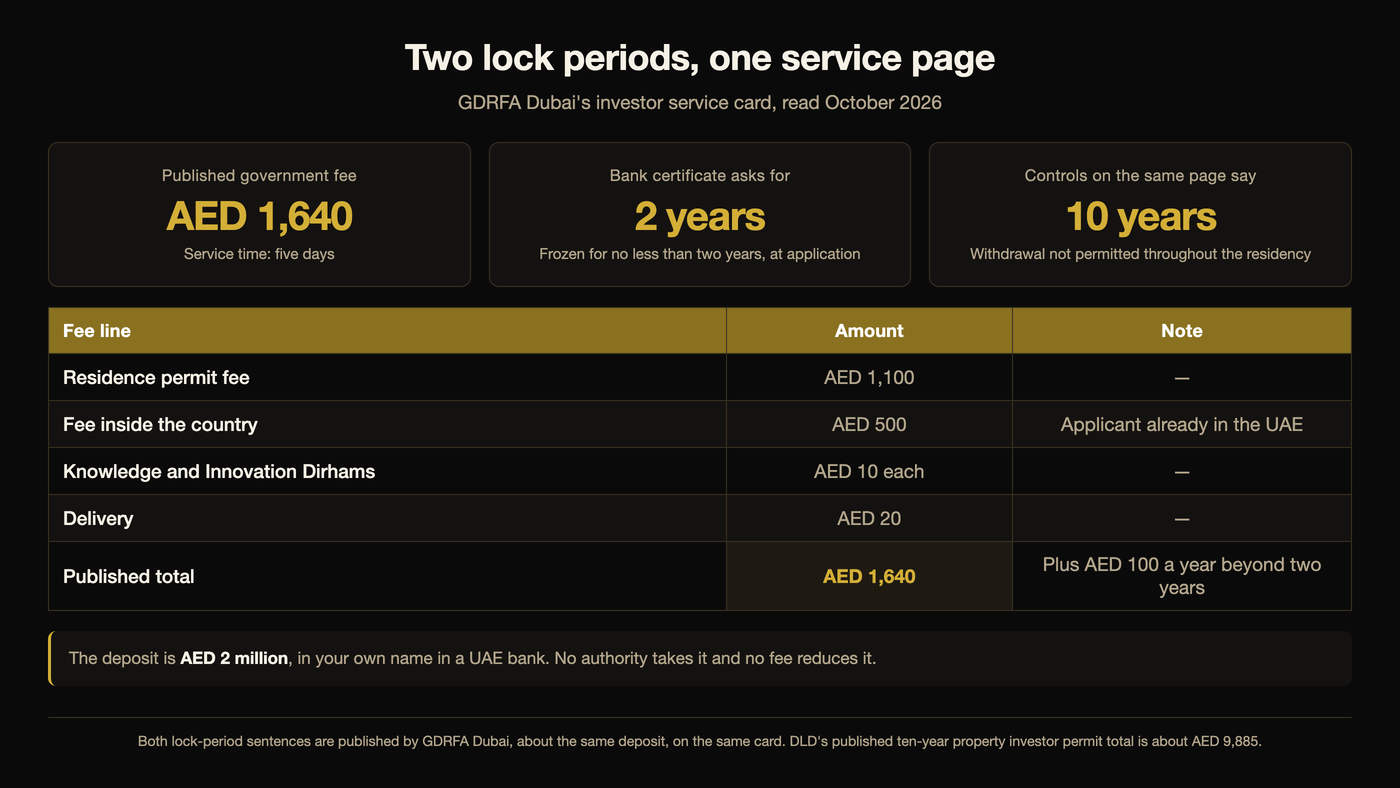
The UAE Golden Visa deposit cost is two numbers that do not belong on the same line. GDRFA Dubai publishes AED 1,640 of fees to issue the permit, and the same page requires an AED 2 million bank deposit it says cannot be withdrawn for the ten years the residency runs. Every commercial page we read quotes the two-year freeze printed on the bank certificate and none of them quotes the ten-year condition printed four paragraphs below it, which is an eight-year difference in when your capital comes back. We read GDRFA Dubai's investor service page, the ICP's golden residency guide and the federal portal's own category table, and priced the route from what they publish. On this page, in order: what the deposit cost actually covers, the lock period published two ways on one page, every fee line in the AED 1,640, why borrowed money disqualifies a deposit but not a property, the four public-investment routes and how their costs differ, whether this permit runs five years or ten, and how to price the decision before you move the money.
What the UAE Golden Visa deposit cost actually covers
Ask what the bank deposit route to a UAE Golden Visa costs and you will be given a fee. That is the least interesting number in the transaction. The UAE Golden Visa deposit cost is really three separate commitments with three different time horizons, and the one that decides whether this route is sensible for you is not a fee at all.
The first layer is the government charge to issue the permit, which GDRFA Dubai publishes in full at AED 1,640 for a file submitted inside the country. The second is the AED 2 million deposit itself, which is not spent but is not available either. The third is everything the published schedules do not mention: the medical fitness test, the Emirates ID, a health insurance policy that has to be in force at the point of application, and in Dubai, proof of housing.
Collapsing those three into a single quoted figure is how this route gets mis-sold. A provider who tells you the Golden Visa costs around AED 15,000 all in is describing the first and third layers and saying nothing about the second, which is the only one measured in millions. We have priced each layer separately below from the authorities' own pages, and left the deposit's opportunity cost as arithmetic you do with your own numbers rather than a figure we invent for you.
One framing is worth fixing before anything else. The deposit is not a payment to the UAE government. No authority takes it, no authority holds it, and it does not reduce by a fee. It sits in a UAE bank in your name, and what you are buying with it is the condition of eligibility, not an asset the state keeps.
- Layer one, the permit: AED 1,640 on GDRFA Dubai's published schedule, plus AED 100 a year where the residency runs over two years.
- Layer two, the deposit: AED 2 million held in a UAE bank, in your name, locked for a period the authority describes in two different ways.
- Layer three, everything else: medical fitness, Emirates ID, comprehensive health insurance in force at application, proof of housing in Dubai, and any provider fee.
- Not a cost: the deposit is not paid to any government body and is not consumed by the application.
The lock period is published two ways on the same page
This is the finding that changed how we would advise anyone on this route, and it sits in plain sight. GDRFA Dubai's investor service page describes the bank deposit option and, in its requirements, asks for an official bank certificate proving the deposit exists and stating that it has been frozen for a period of no less than two years. Two years is also the number almost every commercial page on this topic repeats.
Further down the same page, in the controls for the same option, is this: withdrawal of the deposit or investment is not permitted throughout the Golden Residency period, with the ten-year term stated in brackets. The additional information section says it again from the other direction, noting that property may not be disposed of nor the financial deposit refunded throughout the ten-year residency period.
Both sentences are published by the issuing authority, about the same deposit, on the same service card. They are not describing the same commitment. A certificate that the money is frozen for two years is a document requirement at the point of application. A rule that the money cannot be withdrawn for ten years is a condition of keeping the residency. If the second sentence governs, the capital is unavailable for five times as long as the market tells you.
We checked what the market says against what it cites. One licensed Amer centre's own page reproduces the ten-year condition correctly. Others do not: one agency page states the money must be fixed for a minimum of two years and never mentions the ten-year line, and another states the minimum term is typically one year depending on the bank. None of the three publishes the fee schedule the same authority publishes a few lines above the condition they skipped.
We are not going to resolve a contradiction in an authority's own text by picking the reading we prefer. The practical position is the uncomfortable one: assume the ten-year lock when you decide whether you can afford this route, and get the two-year reading confirmed in writing by GDRFA before you rely on it. Being wrong in that direction costs you eight years of access to AED 2 million. Being wrong in the other direction costs you nothing.
Both quoted conditions were read from GDRFA Dubai's published investor service page in October 2026. Published requirements change, and an apparent contradiction in a government page is a reason to ask the authority directly rather than to prefer whichever reading suits the budget.
The UAE Golden Visa deposit cost at the fee layer: AED 1,640
The fee side of this route is refreshingly concrete, because GDRFA Dubai itemises it. The residence permit fee is AED 1,100. The fee inside the country is AED 500, which applies where the applicant is already in the UAE rather than entering on a permit. The Knowledge Dirham and the Innovation Dirham are AED 10 each, and delivery is AED 20. That is AED 1,640, and the page gives a service time of five days.
There is one line that catches people later. GDRFA notes that the issuance fee increases by AED 100 annually whenever the residency is over two years. On a ten-year permit that is not a trivial footnote, and it is the kind of item a bundled quote absorbs silently. Ask whether it is inside the number you were given.
Compare that to the other investor route on the same page and the arithmetic gets clearer. Dubai Land Department's published total for its ten-year investor residence permit sits around AED 9,885 for the main applicant, because the property route carries DLD charges, valuation work and a lien procedure that the deposit route does not. On fees alone, the deposit route is the cheaper of the two by a wide margin.
On fees alone is doing a lot of work in that sentence. The deposit route is cheaper to process and vastly more expensive to hold, because the property route lets the asset keep working for you and the deposit route does not. Anyone comparing the two on the government fee line is comparing the smallest number in each column.
- Residence permit fee: AED 1,100.
- Fee inside the country: AED 500.
- Knowledge Dirham: AED 10. Innovation Dirham: AED 10.
- Delivery: AED 20. Published total: AED 1,640.
- Published service time: five days. Issuance fee rises by AED 100 a year where the residency exceeds two years.
- For contrast, DLD's published ten-year investor permit total is about AED 9,885 for the main applicant.
Borrowed money disqualifies a deposit but not a property
The single most useful line in the ICP's golden residency guide is in the public investments conditions, and it is one sentence: the invested capital must be fully owned by the investor and must not be derived from a loan, with documents and evidence required demonstrating the source and ownership of the capital. On this route, leverage is not merely discouraged, it is disqualifying.
Now read the real estate conditions on the same page. The investor must own property worth at least AED 2 million registered in their name, and the property may be financed through a loan provided the financing comes from an approved local bank. Off-plan purchases from an approved local developer are also listed. The two routes take exactly opposite positions on borrowed money.
That is why the choice between them is almost never about fees. If you hold AED 2 million in unencumbered cash, the deposit route is the cheaper and faster file. If your AED 2 million is equity you would have to borrow against, the deposit route is closed to you and the property route is open, which is a bigger difference than any fee schedule on either side.
This also explains why the February 2026 property change mattered so much and why it does not help deposit applicants at all. That change removed the requirement to have already paid around AED 1 million before a mortgaged property counted, which widened the property route for financed buyers. The deposit route's capital-source rule was untouched, so the gap between the two on leverage got wider, not narrower.
- Public investments: capital must be fully owned and not derived from a loan, with evidence of source and ownership.
- Real estate: a property financed through a loan is acceptable where the financing is from an approved local bank.
- Real estate also accepts off-plan units bought from an approved local real estate company.
- Both routes require comprehensive and valid health insurance for the investor and family members.
- GDRFA adds, for Dubai property files, a lien on the property to ensure continuity of ownership for the residency's validity.
Four ways to be a public-investment investor, priced differently
The deposit is one of four public-investment options, and they do not cost the same thing to prove. The ICP lists a financial deposit of at least AED 2 million with an investment fund or one of the national banks operating in the UAE; establishing a UAE company with capital of at least AED 2 million; being a partner in an establishment with a financial share of at least AED 2 million; and owning or being a partner in a company paying at least AED 250,000 a year in federal tax.
The evidence burden is where these diverge. The deposit route's documentary load is light: a passport copy, proof of the deposit, and for Dubai, proof of housing in the emirate. The company and partner routes need a certified financial report from an accredited UAE audit firm, a valid trade licence with a partners' appendix, a company bank statement, tax registration with receipts, and for free zone companies a certificate proving capital and the investor's share.
The tax route is different again, and the lightest of the three non-deposit options on paperwork. GDRFA asks for a letter from the Federal Tax Authority confirming the investor is a partner in one or more establishments and pays at least AED 250,000 annually in tax, plus a trade licence with the partners' appendix. GDRFA notes that the earlier practice of attaching a full year of company tax receipts has been suspended in favour of that letter.
The point for budgeting is that audit and licensing work costs real money and real weeks, while a deposit certificate costs a bank visit. If you are choosing between routes you already qualify for, the cheapest file is usually the one with the fewest third parties who have to produce a document about you.
- Deposit: AED 2 million with an investment fund or a national bank. In Dubai, the deposit may be in local sukuk or investment bonds, held with an accredited local bank, plus proof of housing in the emirate.
- Company: establish a UAE company with capital of at least AED 2 million.
- Partner: a financial share of at least AED 2 million in a new or existing establishment.
- Tax: at least AED 250,000 a year in federal tax, evidenced by a Federal Tax Authority letter plus a trade licence with partners' appendix.
- GDRFA evaluates the scale of the facility's investment or employment, administrative efficiency and financial solvency before final approval on the company route.
The AED 2 million and AED 250,000 thresholds, and the documents each route requires, are published per route and change. Confirm the current requirements for the specific route you intend to use with the ICP or GDRFA before paying an auditor, a free zone or a provider for documents.
Ten years or five? Three official pages, two answers
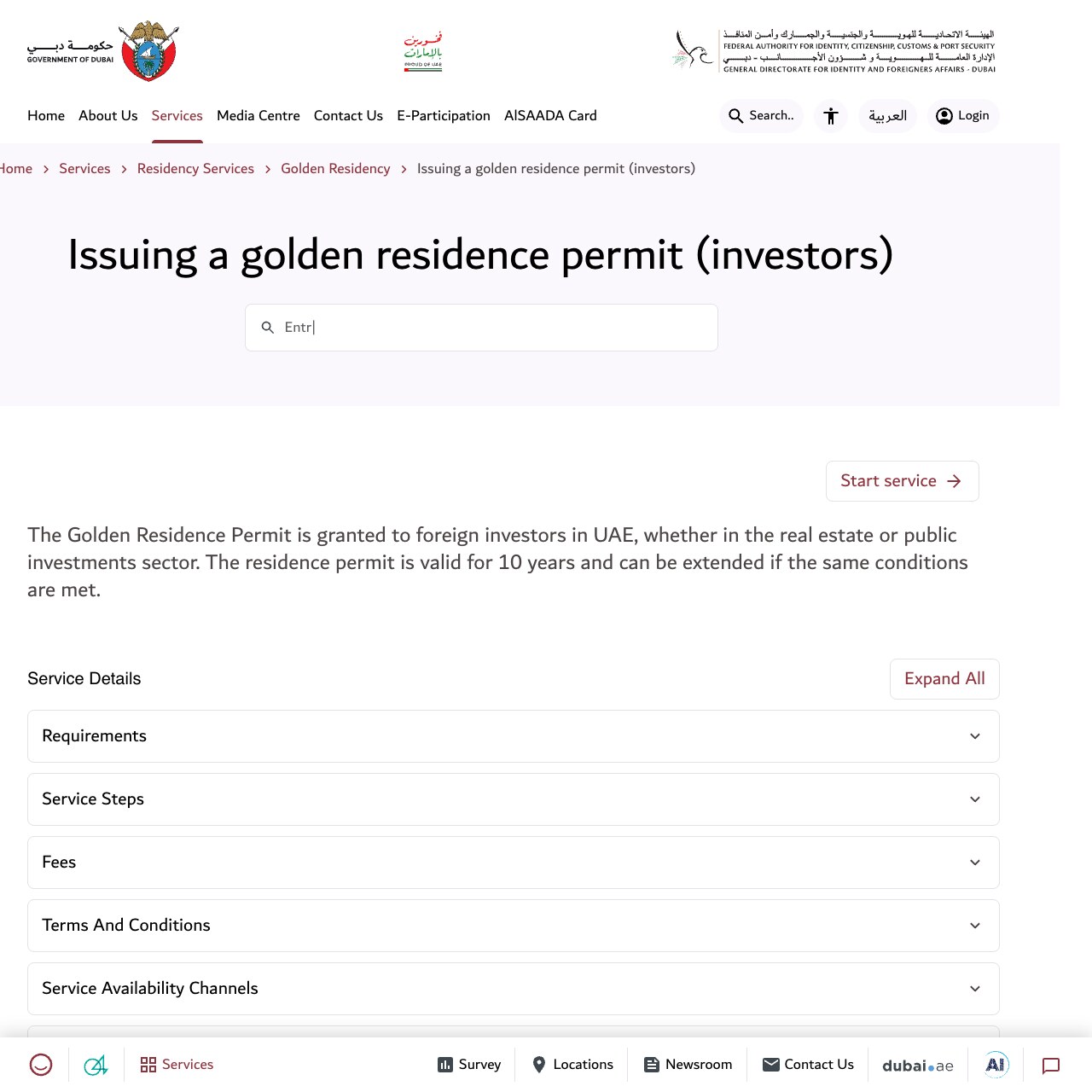
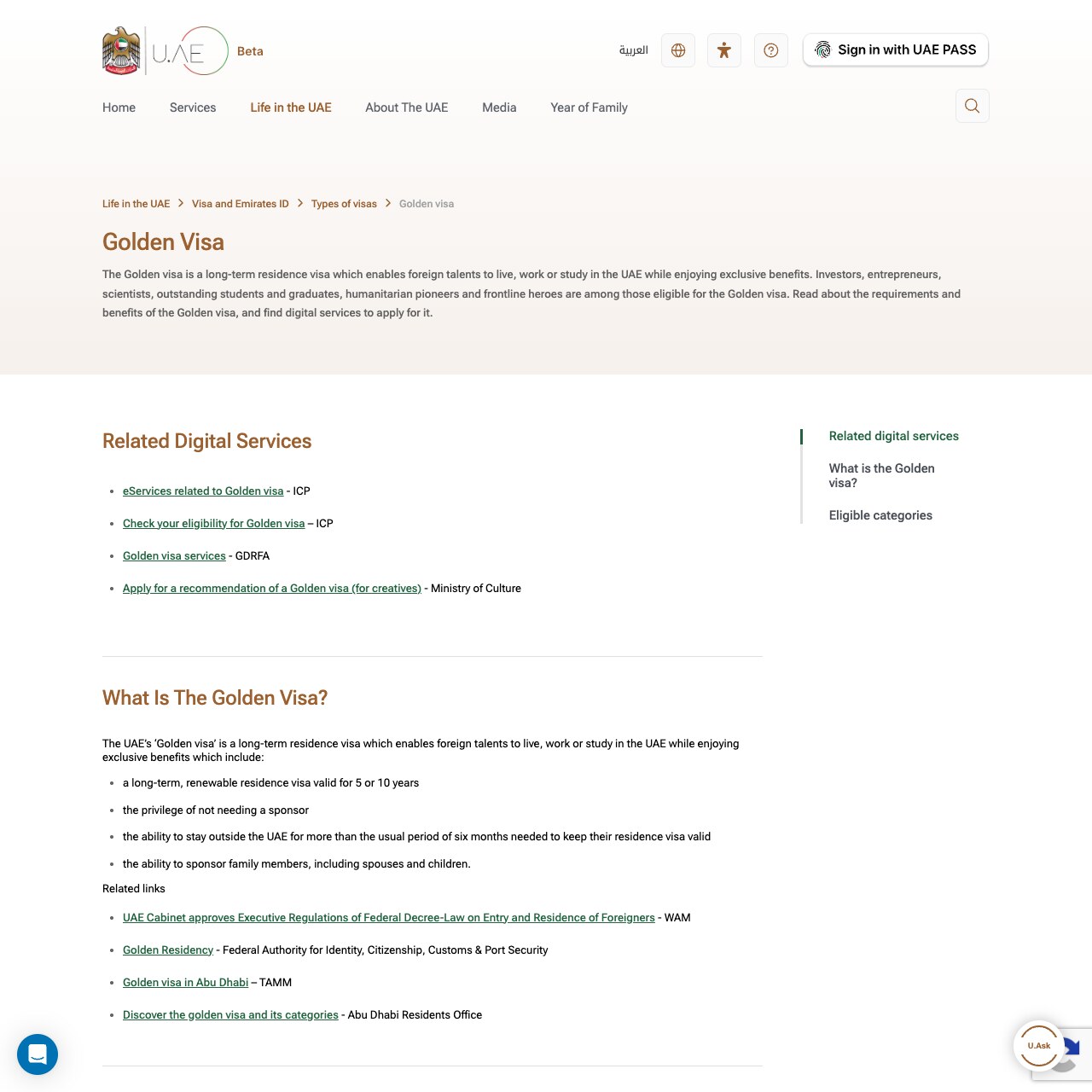
If you are reading several official pages at once, you will hit a discrepancy that matters for cost-per-year. The UAE government portal's category table gives ten years for investors in public investments and five years for real estate investments. The ICP's golden residency guide gives ten years for investors in public investments within the UAE and ten years for investors in the UAE's real estate sector. GDRFA Dubai's investor page says the permit is granted to foreign investors whether in real estate or public investments, and that the residence permit is valid for ten years.
Two of the three say ten years for property; one says five. For the deposit route, all three agree on ten, so a deposit applicant's planning horizon is not in doubt. It is the property comparison that gets distorted, and the distortion runs in a specific direction: pricing a property permit as five years makes its fee-per-year look twice as bad as the issuing authority's own position implies.
We would not treat the outlier as the operative rule, because the authority that issues the permit in Dubai states ten years and the federal authority's detailed guide agrees. But we would not pretend the discrepancy is not there either. If the difference between five and ten years changes your decision, ask the authority handling your file to state the term in writing before you commit capital.
The amortisation is worth doing either way, because it is the one place where the deposit route's cheap fees show up honestly. AED 1,640 across ten years is about AED 164 a year to hold the permit. That is a trivial sum next to the deposit, and it is the clearest demonstration that the fee layer is not what you are actually deciding about.
- Federal portal category table: ten years for public investments, five years for real estate investments.
- ICP golden residency guide: ten years for public investments, ten years for real estate.
- GDRFA Dubai investor service: ten years, for real estate and public investments alike.
- All three agree on ten years for the public-investment deposit route.
- AED 1,640 over ten years is roughly AED 164 a year, before the AED 100 annual issuance increase.
How to price this before you move AED 2 million
The honest way to price the deposit route is to stop treating it as a visa fee question. Take the AED 1,640, add the medical, Emirates ID, insurance and housing-proof items, and you have a few thousand dirhams. Then take AED 2 million, multiply it by the return you would otherwise expect, multiply that by the number of years you believe it is locked, and subtract whatever the UAE deposit itself pays you. That difference is the cost of this route, and it is two or three orders of magnitude larger than the fees.
We are deliberately not filling in those percentages. Deposit rates, your alternative use of the capital and your tax position are all yours, and a worked example with invented rates would be the same mis-selling we are describing. What we will say is that the lock-period question from earlier is the single biggest input into that calculation, which is why it is worth a written answer from GDRFA rather than a provider's reassurance.
Two practical notes before you commit. Confirm the bank will issue a freeze certificate in the form the authority asks for, because not every institution's standard letter says what the service card wants it to say. And remember that nomination, eligibility and a complete file are not approval: GDRFA states plainly on its golden residence pages that initial approval from a nominating body does not constitute final approval, and reserves the right to check that conditions continue to be met across the permit's life.
One insurance point, because it catches people in the gap. The ICP requires comprehensive and valid health insurance at the time of applying, and a UAE-licensed policy is a residence condition you will hold for the life of the permit. If you are travelling while a file is in progress and do not yet hold that policy, travel medical cover is a different product that bridges trips only.
Nothing here is tax, legal or investment advice, and no figure on this page is a promise about approval, the term of a permit, or when a deposit is released. Published fees, lock periods and eligibility conditions change. Verify every number against the authority handling your file before you commit capital.
SafetyWing sells travel medical cover for trips taken before a UAE-licensed policy is in force. It is not a UAE-licensed health policy, it does not satisfy the comprehensive health insurance condition the ICP applies to Golden Residency, it does not affect a decision or a processing time, and it is not a substitute for the resident policy you will need once a permit is issued.
Sponsored link. We may earn a commission at no cost to you.Common questions
How much does the UAE Golden Visa deposit route cost in fees?
GDRFA Dubai publishes AED 1,640 to issue the golden residence permit for investors: AED 1,100 for the residence permit, AED 500 as the fee inside the country, AED 10 each for the Knowledge and Innovation Dirhams, and AED 20 for delivery. The page gives a service time of five days and notes that the issuance fee increases by AED 100 annually where the residency runs over two years. Medical fitness, Emirates ID, health insurance and any provider fee sit outside that total.
Is the AED 2 million deposit locked for two years or ten?
GDRFA Dubai's investor service page says both, and that is the honest answer. Its requirements ask for a bank certificate stating the deposit has been frozen for no less than two years, while its controls for the same option state that withdrawal of the deposit or investment is not permitted throughout the Golden Residency period of ten years, and its additional information repeats that the deposit may not be refunded throughout the ten-year period. Budget on the ten-year reading and ask GDRFA to confirm in writing before relying on the two-year one.
Can I borrow the AED 2 million for the deposit?
No. The ICP's golden residency guide states that invested capital must be fully owned by the investor and must not be derived from a loan, and requires documents evidencing the source and ownership of the capital. This is the opposite of the real estate route, where the same guide allows a property financed through a loan from an approved local bank. If the money would be borrowed, the deposit route is not available to you.
Does the deposit have to sit in a bank, or can it be in a fund?
The two authorities word this differently. The ICP describes a financial deposit of at least AED 2 million with an investment fund or one of the national banks operating in the UAE. GDRFA Dubai describes depositing a fixed sum with a local bank in the UAE or holding it in the form of local bonds or sukuk, with the deposit held at an accredited local bank. If a fund is central to your plan, confirm the instrument with the authority that will handle your file before you move anything.
Is the deposit route cheaper than the property route?
At the fee layer, clearly yes. GDRFA lists AED 1,640 for the investor permit, while Dubai Land Department's published total for its ten-year investor residence permit is around AED 9,885 for the main applicant, because the property route adds DLD charges, valuation and a lien procedure. Over the life of the permit the comparison usually reverses, because a property can keep working for you and a frozen deposit cannot.
What extra documents does Dubai ask for on the deposit route?
GDRFA Dubai lists a passport copy, proof of ownership of a financial deposit of no less than AED 2 million in a local UAE bank, which may be in the form of local sukuk or investment bonds, and proof of housing in the Emirate of Dubai. That housing requirement is the one most provider quotes we read leave out, and it is a tenancy or ownership cost rather than a fee.
How long does the deposit route Golden Visa last?
Ten years, and all three official pages we checked agree on that for public investments. The ICP's guide and GDRFA Dubai both also give ten years for the real estate route, while the federal portal's summary table lists five years for real estate investments, so the discrepancy is on the property side rather than the deposit side. GDRFA adds that golden residence holders are exempt from the 180-day rule, with the residency void only if it expires outside the country.
Does meeting the AED 2 million condition guarantee approval?
No. GDRFA states that initial approval from a nominating body does not constitute final approval, and that final approval follows its own review of the file against the approved conditions and criteria. It also reserves the right to take measures to ensure holders continue to meet the conditions throughout the permit's validity, and lists the ability to support yourself and your family without government support among those conditions. Treat any provider promising approval as describing their own confidence, not a published rule.
Sources to verify before applying
- Issuing a golden residence permit (investors) — fees and the 180-day exemptionGDRFA Dubai
- Golden Residency Guide — categories, residency durations and key documentsFederal Authority for Identity, Citizenship, Customs and Port Security
- Golden visaThe Official Portal of the UAE Government
- Golden ResidencyFederal Authority for Identity, Citizenship, Customs and Port Security
- Abu Dhabi Golden Visa for Real Estate Investors — conditions and documentsAbu Dhabi Department of Economic Development
- Golden Visa application - InvestorDubai Land Department
- General provisions for the residence visaThe Official Portal of the UAE Government
Compare UAE Golden Visa providers.
Get a line-item quote before you pay. Ask providers to separate government charges, document costs, and service fees.
We may earn a referral fee if you choose an advisor or provider through this site. That does not change our requirement to describe fees and eligibility conservatively.