uae golden visa for coders cost
UAE Golden Visa for Coders Cost 2026
Search the UAE Golden Visa for coders cost and you get ranges — AED 3,500 to AED 10,000, or "about AED 4,000" — none of them traceable to a published schedule, and all of them bolted to an AED 30,000 salary bar that one of the two coder routes does not impose. The real figures are smaller and stranger: GDRFA Dubai lists AED 1,640 for the permit and the federal ICP lists AED 300, while the route most coders actually want asks for a passport copy and a nomination letter, and no degree at all. We read both permit schedules line by line, the ICP's specialised-talents service sheet and GDRFA's Talented Geniuses service, and separated what the permit costs from what the file costs.
Two coder routes that share a name and nothing else
A coder asking what the UAE Golden Visa costs is usually being answered about the wrong route. The pages ranking for this query describe one visa: a ten-year residence for software people, earned with a computer science degree, five years of experience and a UAE contract paying AED 30,000 a month. That description is accurate for one of the two routes and materially wrong for the other.
The second route is the one the National Program for Coders was built around. GDRFA Dubai runs it as a service called Talented Geniuses, which sits alongside culture, innovation and sport, and it lists digital technology talents as one of its four categories. Its required documents are a copy of the sponsored person's passport and a nomination letter from the Emirates Council for Artificial Intelligence and Digital Transactions. There is no degree on that list, no employment contract and no salary certificate. The Council's nomination is the whole gate.
That single difference reorganises the budget. On the salaried route the largest non-visa cost is usually the Ministry recognition report on a foreign degree, which runs on the ministry's calendar rather than yours. On the nomination route that cost does not arise, because nothing in the published document list asks for it. A provider quoting one set of fees for "the coders Golden Visa" is quoting a route, not a category, and it is worth asking which one.
On this page, in order: the two routes and who nominates on each; the nomination route's document list; the salaried route's conditions; what each authority publishes for the permit; the per-year increase that sits under both figures; the Emirates ID and medical bills that belong to other authorities; what the 100,000-visa programme does and does not promise; Abu Dhabi's version of the same route; and the costs no schedule carries. Fees and rules are set by the issuing authorities and change without notice, so confirm every figure here against the authority's own page before you budget against it.
The nomination route: two documents and one council
GDRFA Dubai's Talented Geniuses service is unusually short. For digital technology talents it asks for a copy of the sponsored person's passport and a nomination letter from the Emirates Council for Artificial Intelligence and Digital Transactions, and that is the published list. The other three categories on the same service work the same way with different nominators: the Ministry of Culture, Dubai Culture and Arts Authority or the Emirates Media Council for culture and art, the Ministry of Economy or a competent local authority for innovators and inventors, and the Ministry of Sports or Dubai Sports Council for athletes.
The federal ICP describes its side the same way. Its residence visa for individuals with specialised talents sorts applicants by the authority that endorses them, and for digital technology the endorsement comes from the UAE Council for Artificial Intelligence and Digital Transactions. Alongside that it asks for a passport with at least six months of validity and valid UAE health insurance. Again, no degree threshold and no salary figure appear in the published conditions.
What the Council weighs is not published in the same way, and that is the honest limit of this section. The criteria it applies to a portfolio, a research record, a role at a large technology firm or an open-source body of work are not set out as a fee-table equivalent, and nobody outside the Council can tell you in advance whether a given file clears it. What can be said is what the paperwork costs, which is almost nothing, and where the uncertainty actually sits, which is in a decision rather than in a budget.
The practical consequence is that this route is cheap to attempt and impossible to buy. A provider can assemble the file, but the nomination is a government decision and no fee moves it. Treat any quote that prices a nomination as a deliverable with real caution.
- GDRFA digital technology documents, as published: passport copy, and a nomination letter from the Emirates Council for Artificial Intelligence and Digital Transactions.
- ICP specialised-talents conditions: endorsement from the UAE Council for Artificial Intelligence and Digital Transactions, a passport valid at least six months, and valid UAE health insurance.
- Not on either list: degree recognition report, employment contract, salary certificate, MOHRE classification level.
- Also stated by GDRFA: retaining the permit requires the ability to support yourself and your family without government support.
The Council's nomination is a government decision, not a purchasable service. No provider and no fee can commit to obtaining one, and a quote that prices a nomination as a deliverable is selling something it does not control.
The salaried route: AED 30,000 and a recognised degree
The other way in is the skilled-professional branch of GDRFA's specialists service, and it is the one every ranking page describes. Its conditions are specific: a MOHRE first or second professional level classification, a bachelor's degree or equivalent, an employment contract, and a monthly salary of no less than approximately AED 30,000. Where the degree was issued outside the Emirates, a Ministry of Education recognition report is required, which is where most of the real money on this route goes.
The Ministry of Higher Education and Scientific Research runs that service. Its page describes qualification verification through one of the ministry's approved partners at a fee of 350, and recognition report fees beginning at AED 100 for diploma and bachelor's categories, with a service time of 18 working days and a note that additional documents may be requested. Attestation and translation of the original degree are separate again, priced by the issuing country's authorities rather than by anyone in the UAE.
The salary condition is also the one condition on either route that can be breached after approval. GDRFA states that the authority reserves the right to ensure holders continue to meet the conditions throughout the validity period, and that where the salary falls below the threshold or the contract is cancelled, the Golden Residence Permit will be cancelled. A ten-year permit earned on a salary is a ten-year permit conditional on that salary. A permit earned on a nomination is not conditional in the same way, which is a genuine argument for filing under the Council if you can.
For a coder with a foreign computer science degree and a Dubai contract, both routes may be open at once. The cheaper file is the nomination; the more predictable file is the salary, because its conditions are published and testable in advance. That trade — cost and document load against certainty of criteria — is the actual decision, and no competitor page frames it.
- MOHRE professional level: first or second.
- Education: bachelor's degree or equivalent, with a Ministry of Education recognition report where the degree was issued abroad.
- Salary: no less than approximately AED 30,000 a month, evidenced by contract and salary certificate.
- MOHESR service: verification fee of 350 through an approved partner, recognition report fees from AED 100, service time 18 working days.
- Continuing condition: GDRFA states the permit will be cancelled if the salary falls below the threshold or the contract is cancelled.
MOHESR fees and service times are published on the ministry's own service page and change without notice. Confirm the current verification and recognition report fees before budgeting, and allow separately for attestation and translation in the country that issued the degree.
What each authority charges for the permit itself
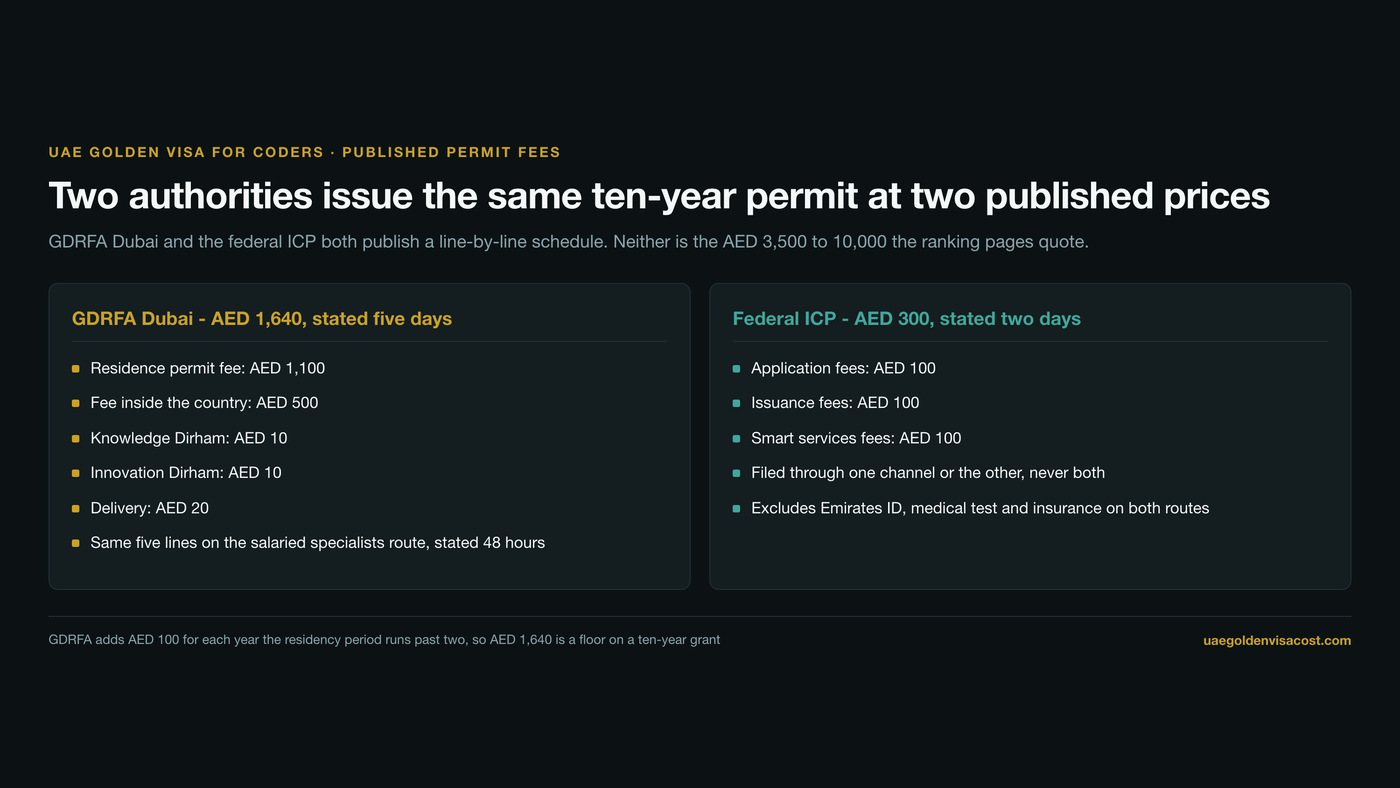
Two authorities issue the same ten-year permit and publish two different prices for it, which is the single biggest reason coder cost estimates online disagree with each other by a factor of ten.
GDRFA Dubai itemises the Talented Geniuses permit as a residence permit fee of AED 1,100, a Knowledge Dirham of AED 10, an Innovation Dirham of AED 10, a fee inside the country of AED 500, and delivery of AED 20. That comes to AED 1,640 for the main applicant, and GDRFA states the service duration as five days. The specialists service used by the salaried route publishes the identical five lines and the same AED 1,640, at a stated 48 hours.
The federal ICP prices its specialised-talents residence visa in three lines of AED 100: application fees, issuance fees and smart services fees. That is AED 300, at a stated two days. Nothing is missing from either schedule; they are simply schedules for different issuing channels, and an applicant files through one of them rather than both.
Set those against what the ranking pages say. One states the total application cost at approximately AED 4,000. Another prints an "ICP Coder Track" at AED 4,500 to 6,500 and a "GDRFA Highly Skilled Engineer" track at AED 3,800 to 5,500. Those numbers are not the permit. They are the permit plus an Emirates ID, a medical test, insurance and an unstated service fee, blended into a range with no source attached — which is fine as a budget and useless as a fee schedule, because you cannot tell which line you are being charged twice for.
- GDRFA Dubai, Talented Geniuses (digital technology): AED 1,100 permit + AED 500 inside the country + AED 10 Knowledge Dirham + AED 10 Innovation Dirham + AED 20 delivery = AED 1,640, stated at five days.
- GDRFA Dubai, specialists route (salaried): the same five lines, the same AED 1,640, stated at 48 hours.
- Federal ICP, specialised talents: AED 100 application + AED 100 issuance + AED 100 smart services = AED 300, stated at two days.
- Not included in either: Emirates ID, medical fitness test, UAE health insurance, typing or centre handling fees, and any provider service fee.
The AED 100-a-year escalator no quote includes
Both GDRFA services carry the same footnote, and it changes the arithmetic on a ten-year grant: the issuance fee increases by AED 100 for each year where the residency period is more than two years. Read literally, AED 1,640 is the floor of the published schedule on a ten-year permit, not the total.
GDRFA does not print a worked ten-year figure, so neither will we. What the footnote establishes is the shape of the number rather than the number itself, and the shape matters: a quote that shows AED 1,640 as the permit cost on a ten-year Golden Visa has quoted the two-year base and stopped reading. Ask the provider, or the Amer centre, for the exact issuance total for your term before you transfer anything.
The ICP schedule does not carry the same note on its specialised-talents service, which is one more reason the two figures are not comparable line for line. They are different channels with different pricing logic, and the honest answer to "which is cheaper" is that it depends on which one your file goes through, and that you do not usually get to choose freely.
The AED 100-per-year increase is published by GDRFA as a condition of the issuance fee, not as a worked total. Get the exact figure for your permit length confirmed by the issuing authority before budgeting.
Emirates ID and the medical test are billed by someone else
The permit is not the card, and the card has its own price list. The ICP charges AED 100 for each year of residence for an Emirates ID, plus AED 100 in smart service fees, with urgent service at AED 150 on top. On a ten-year Golden Visa that is AED 1,000 plus AED 100, so the card alone costs more than the ICP's entire permit schedule and roughly two thirds of GDRFA's. Every person on the application gets their own card and pays their own fee.
The medical fitness test is a health authority charge, not a residency one. Dubai Health Authority's published catalogue starts at AED 250 for the regular service at 24 working hours, AED 700 express at six working hours and AED 1,020 for VIP at two working hours, and it applies per person aged 18 and over. Neither GDRFA nor the ICP includes a dirham of it, and neither is wrong to omit it — it is simply a different authority's bill.
UAE health insurance is the third. It is a stated condition on the ICP's specialised-talents service and it is charged on an insurer's annual cycle rather than on the permit's ten-year one, so it is a recurring cost sitting behind a one-off headline. Budget it as a subscription, not as a line item.
Add those three to the permit and a single coder's ten-year file in Dubai is plainly in the low thousands of dirhams before anyone's service fee — which is roughly where the ranges online land, just without any way to check them. The difference is that you can now see which authority charges which line, and challenge a quote that double-counts one.
- Emirates ID: AED 100 per year of residence plus AED 100 smart services, so AED 1,100 on a ten-year card; urgent service adds AED 150.
- Medical fitness, Dubai Health Authority published catalogue: from AED 250 regular, AED 700 express, AED 1,020 VIP, per person aged 18 and over.
- UAE health insurance: a stated condition, priced by the insurer on an annual cycle.
- Each of these is charged per applicant, so a family multiplies all three.
Emirates ID, medical fitness and health insurance are charged by three different authorities on three different cycles. None of them appears on a GDRFA or ICP permit schedule, and all three are billed per person.
SafetyWing sells travel medical cover for the window before a UAE-licensed policy is in force — a scouting trip, or the weeks between contracts. It is not a UAE-licensed health policy, it does not satisfy the health insurance condition on any Golden Visa route, and it has no bearing on a Council nomination or an application. The cover your file needs must be valid in the UAE and should be budgeted separately. We may earn a referral fee if you use this link.
Sponsored link. We may earn a commission at no cost to you.What 100,000 Golden Visas for coders actually promises
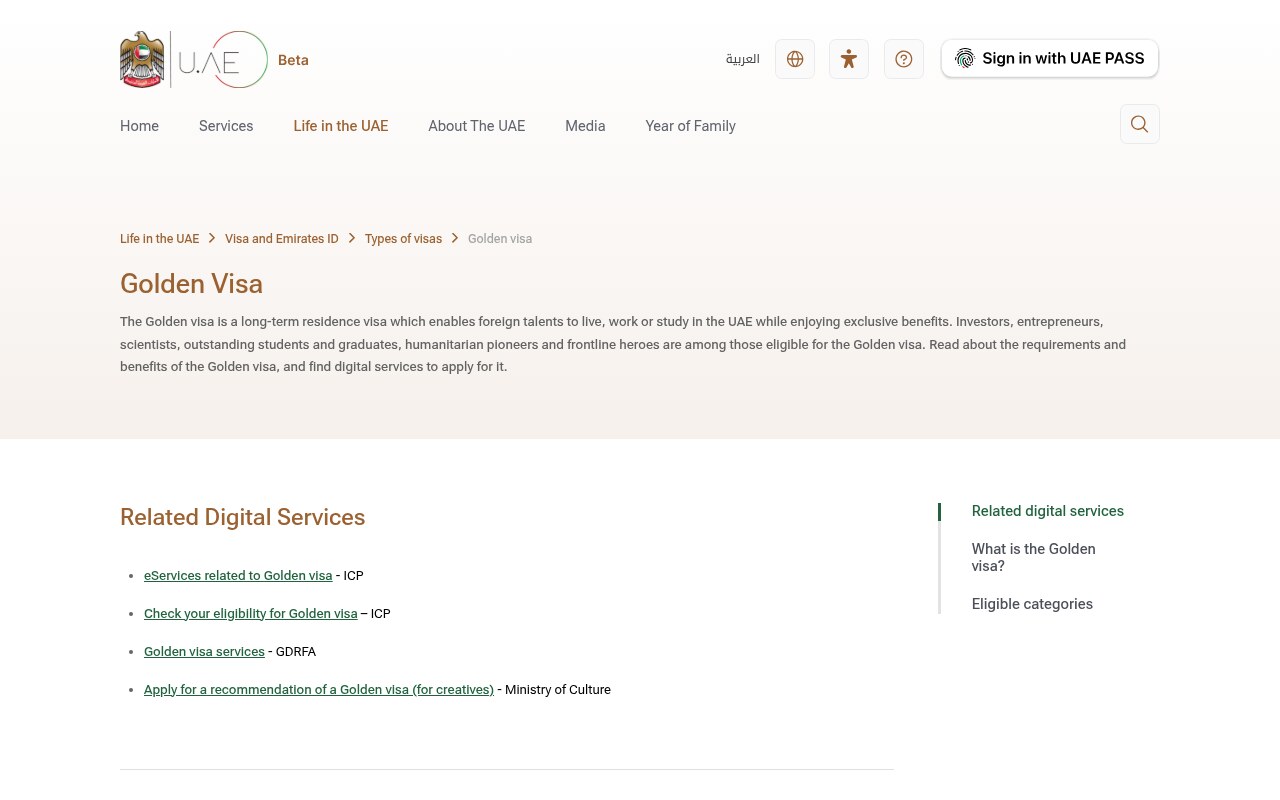
The National Program for Coders is the reason this query exists. The UAE government's own portal states the programme will grant Golden visas to 100,000 of the world's best coders, and sets its five-year targets as attracting and training 100,000 coders, establishing 1,000 digital companies, and increasing investment in start-ups from AED 1.5 billion to AED 4 billion. It is managed by the Artificial Intelligence Office, and the portal routes applicants to the ICP's smart services platform and to Coders HQ, the coders community in the UAE.
What the portal does not publish is an eligibility list for the visa. It does not state a minimum number of years of experience, a required degree, or a salary threshold. The widely repeated "five years of experience and a bachelor's degree attested by the Ministry of Education" is not on the government page; it is a summary written by advisory firms, and it reads like a description of the salaried specialists route rather than of the programme. We could not verify it against a primary source, so we are not going to state it as a rule.
That is not a reason to discount the programme. It is a reason to file against the conditions that are published — GDRFA's document list and the ICP's service sheet — rather than against a checklist assembled from secondary summaries. A headline number of 100,000 visas is a policy target, not an entitlement, and nothing in it changes what the issuing authority asks you for.
Abu Dhabi runs the same route through a different door
Abu Dhabi publishes its own digital-technology category. The Department of Economic Development lists a ten-year Golden Visa for talents in digital technology, and its stated requirement is a recommendation from the Emirates Council for Artificial Intelligence and Digital Transactions or a local competent authority — the same nominator as the Dubai route.
The operational detail matters more than the eligibility here. That page states that submissions for this category are currently not available via the Abu Dhabi Residents Office, and directs applicants to the TAMM platform. A channel being closed is not the same as a category being closed, but it does mean an Abu Dhabi-based coder should confirm the live channel before assembling a file, because the document list is worth nothing if there is nowhere to file it this month.
Neither the ADDED page nor TAMM publishes a fee table for this category in the way GDRFA and the ICP do, so an Abu Dhabi cost estimate has to be built from the federal ICP schedule plus the Emirates ID and medical lines. Any provider quoting a firm Abu Dhabi total for a digital-technology nomination is quoting its own pricing, not a government one.
The costs on no fee schedule, and the approval nobody promises
Three costs on a coder's file appear on nobody's published schedule. Typing and handling at an Amer or TAMM service centre is charged by the centre and published by no authority. Translation and home-country attestation of a degree, on the salaried route, is priced by the issuing country. And a provider's own service fee is the largest variable of the three, because it is the only one nobody has to justify against a government line.
The last of these is where a quote should be interrogated hardest. On the nomination route in particular, the government paperwork is a passport copy and a letter, and the work a provider genuinely adds is in preparing a case for the Council — which is real work, and also work whose outcome nobody controls. A fee for that is legitimate. A fee presented as buying a nomination is not, and no one is in a position to promise approval on either route.
Timing splits the same way. GDRFA states five days for the Talented Geniuses permit and 48 hours for the specialists permit, and the ICP states two days for its specialised-talents visa — but those clocks start when a complete file arrives. On the salaried route the Ministry recognition report alone is an 18-working-day service before anything reaches immigration, and a Council nomination carries no published turnaround at all. Plan the file in months and the permit in days.
If you take one thing from the fee tables, take this: the permit is the cheapest part of a coder's Golden Visa, and the part with a published price. Everything expensive about it is either somebody else's bill or somebody else's decision.
- Typing or handling at an Amer or TAMM centre — charged by the centre, published by no authority.
- Degree attestation and translation on the salaried route — priced abroad, before the UAE recognition report.
- Provider service fees — the largest variable, and the one with no government line to check it against.
- Published service times: GDRFA five days (Talented Geniuses) and 48 hours (specialists); ICP two days; MOHESR recognition 18 working days; Council nomination, not published.
Common questions
How much does the UAE Golden Visa for coders cost in 2026?
The permit itself is published. GDRFA Dubai lists AED 1,100 for the residence permit plus AED 500 inside the country, AED 10 each for the Knowledge and Innovation Dirhams and AED 20 delivery, which is AED 1,640, and it states the issuance fee rises by AED 100 for each year the residency runs beyond two. The federal ICP lists three fees of AED 100 for a total of AED 300. The Emirates ID at AED 100 per year of residence, the medical fitness test from AED 250 and UAE health insurance are separate bills from other authorities.
Do coders need a degree for the UAE Golden Visa?
It depends on the route. GDRFA's Talented Geniuses service, which covers digital technology talents, lists only a passport copy and a nomination letter from the Emirates Council for Artificial Intelligence and Digital Transactions among its required documents — no degree appears. The skilled-professional route does require a bachelor's degree or equivalent, with a Ministry of Education recognition report where the degree was issued outside the UAE.
Is there an AED 30,000 salary requirement for coders?
On the skilled-professional route, yes: GDRFA states a monthly salary of no less than approximately AED 30,000 alongside a MOHRE first or second professional level classification. On the digital-technology nomination route no salary figure appears in the published conditions at all. Most guides apply the salary bar to both, which is the single most common error in this topic.
Who nominates a coder for the UAE Golden Visa?
The Emirates Council for Artificial Intelligence and Digital Transactions. GDRFA names it as the nominator for digital technology talents, the ICP names it as the endorsing body for the digital technology branch of its specialised-talents visa, and Abu Dhabi's Department of Economic Development names the same Council, or a local competent authority, for its digital technology category. The Council does not publish its assessment criteria in fee-table form, so no adviser can tell you in advance whether a file will clear.
Is the National Program for Coders still running?
The UAE government portal still publishes the programme, states its goal of granting Golden visas to 100,000 of the world's best coders, and routes applicants to the ICP smart services platform and to Coders HQ. The portal does not publish a visa eligibility checklist, so file against the conditions the issuing authority publishes rather than against a list compiled from advisory summaries.
Can a coder apply from outside the UAE?
Nothing in the published conditions for either route states that you must already hold a UAE residence visa: the ICP's specialised-talents sheet asks for a passport valid at least six months and valid UAE health insurance, and GDRFA's digital-technology list asks for a passport copy and the Council's nomination letter. Note that GDRFA's fee schedule includes a fee inside the country of AED 500, which implies the in-country issuance path, so confirm the channel and the fee lines that apply to your situation with the authority before you budget.
How long does a coder's Golden Visa take?
The permit step is quick — GDRFA states five days for the Talented Geniuses service and 48 hours for the specialists service, and the ICP states two days — but the clock starts when a complete file arrives. On the salaried route the Ministry of Higher Education and Scientific Research recognition report is an 18-working-day service on its own, and a Council nomination has no published turnaround. Plan the file in months and the permit in days.
Does the Emirates ID cost extra on a coder's Golden Visa?
Yes, and it is charged by a different authority on a different basis. The ICP prices the card at AED 100 for each year of residence plus AED 100 in smart service fees, so a ten-year Golden Visa card is AED 1,100 and urgent service adds AED 150. Everyone on the application pays their own. A quote showing one flat Emirates ID figure regardless of permit length is not quoting the published schedule.
Sources to verify before applying
- Issuance of a golden residence permit (Talented Geniuses) — digital technology nomination, document list and published fee linesGDRFA Dubai
- Issuance of a Residence Visa for Individuals with Specialized Talents — fee lines and required approvalsFederal Authority for Identity, Citizenship, Customs and Port Security
- The National Program for Coders — 100,000 Golden Visas and the five-year targetsThe Official Portal of the UAE Government
- Abu Dhabi Golden Visa for Talents in Digital Technology — ten years on an Emirates Council recommendationAbu Dhabi Department of Economic Development
- Issuing Golden Residence Permit (Specialized Scientists) — elite education fields, specialists and published feesGDRFA Dubai
- Recognition of higher education qualifications issued outside the UAEMinistry of Higher Education and Scientific Research
- New Identity Card Issuance — published fee scheduleFederal Authority for Identity, Citizenship, Customs and Port Security
- Medical Fitness Centres Service Catalogue — published screening fee scheduleDubai Health Authority
Compare UAE Golden Visa providers.
Get a line-item quote before you pay. Ask providers to separate government charges, document costs, and service fees.
We may earn a referral fee if you choose an advisor or provider through this site. That does not change our requirement to describe fees and eligibility conservatively.